“Azov” Cuts Russia’s Land Corridor to Crimea, Destroying Putin’s Only Strategic Achievement

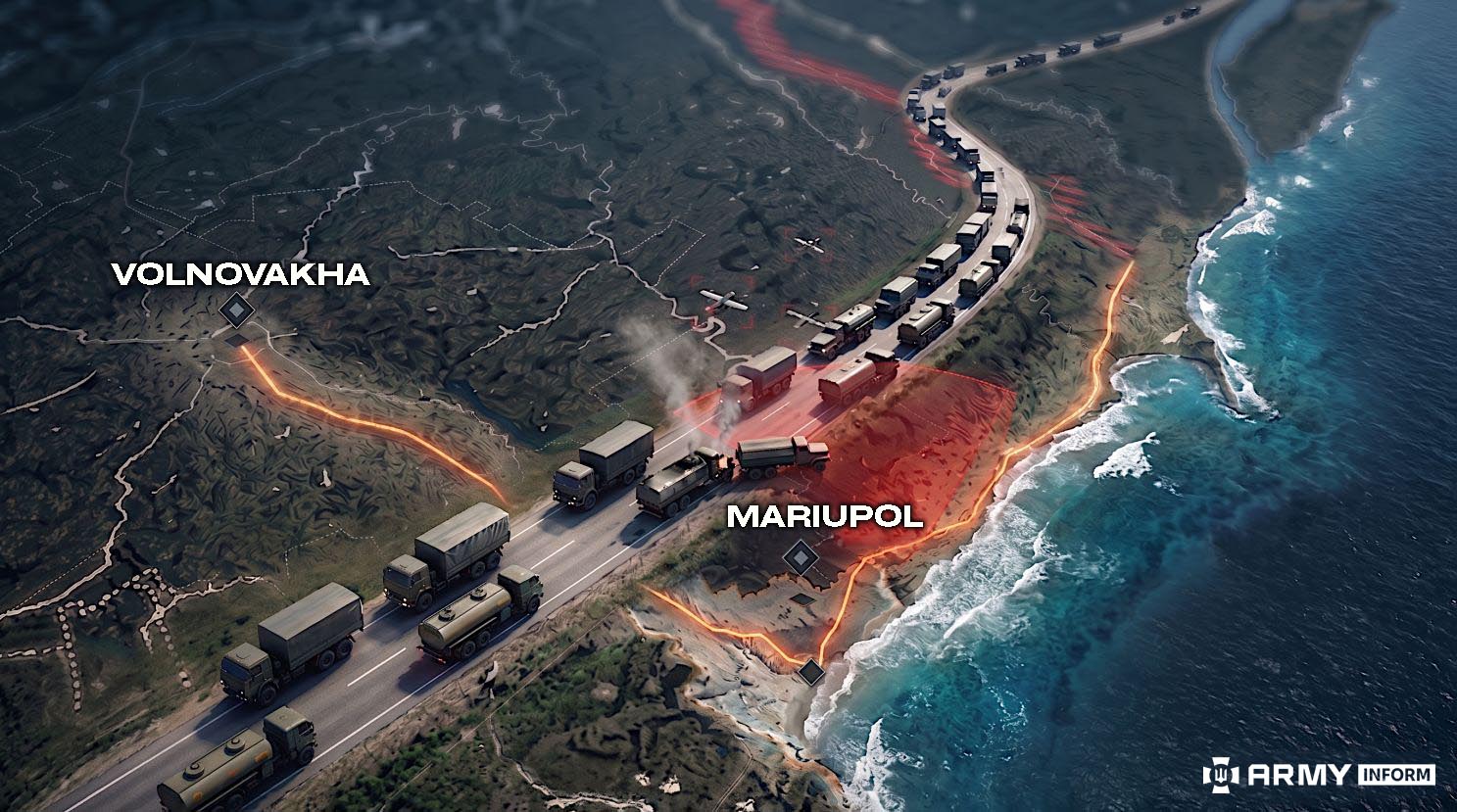
Since the beginning of the full-scale invasion, the Russian invaders have attempted to transform the occupied Azov region into a safe rear and a key logistical artery.
Following the occupation of parts of the Zaporizhzhia, Donetsk, and Kherson oblasts, the Russian military established a land corridor to occupied Crimea, operating under the assumption that Ukrainian strike capabilities would be unable to consistently target such depths.
In the long term, however, Russia’s plans have collapsed. The enemy severely underestimated the ingenuity of Ukrainian military specialists. As of May 2026, drones from the 1st Corps of the National Guard of Ukraine (NGU) “Azov” are interdicting enemy logistics in the area of temporarily occupied Mariupol with relative ease. This is vividly illustrated by numerous videos featuring the whining of Russian occupiers who are forced to use these routes to supply their grouping in the southern direction.
According to some reports, the current operational depth of Ukrainian short-range strike UAVs is approximately 160 kilometers. This means that rear routes, which the enemy until recently considered relatively safe, are progressively turning into high-risk zones.
Fundamentally, this is not just about isolated strikes, but about shifting the very paradigm that previously allowed the Russian army to utilize the roads around Mariupol as a deep rear with absolute impunity. For the occupiers, the consequence will be the necessity to scout alternative routes, resulting in the diversion of additional resources and the loss of precious time.
As “Azov” representatives emphasize, their objective is to push the “sanitary zone” for Russian logistics closer to the borders of the Russian Federation itself and occupied Crimea.
“There will no longer be a safe Azov region for the occupiers,” Ukrainian warriors state.
Panic in the Z-Channels and Imposed Restrictions
Against this backdrop, genuine hysteria has erupted among Russian propagandists. Despite the real risk of facing repression for “discrediting the army,” so-called Z-vloggers are no longer hiding their outrage over the Russian Armed Forces command’s inability to protect logistical routes, even deep in the rear.
Russians complain that Ukrainian drones are reaching areas where no systemic threat was previously anticipated, delivering an especially painful blow to their pride.
Furthermore, Vladimir Saldo, the Kremlin’s proxy gauleiter in the temporarily occupied territory of the Kherson oblast, was forced to restrict civilian traffic along these highways—making exceptions only for trucks carrying military cargo, fuel, and basic food supplies. By doing so, he effectively admitted that the route is under Ukrainian fire control.
Thus, the land corridor to the occupied peninsula, which Russian dictator Vladimir Putin touted as an undeniable strategic achievement, is increasingly becoming a zone of constant danger for the aggressor country’s army. The deeper “Azov” operates within the enemy’s rear, the less space the occupiers have left to feel unreachable.
Scaling up the Middle Strike Capability
At the same time, despite the initial successes demonstrating the vulnerability of Russian logistics in the Azov region, the Defense Forces need to scale this effect to transform individual successful strikes into the systemic exhaustion of enemy logistics.
This is precisely why Ukraine is ramping up the frequency of middle-strike drone operations at depths ranging from dozens to hundreds of kilometers from the front line. In addition to logistics, our medium-range drones are destroying Russian air defense systems, command posts, and oil and energy infrastructure facilities.
An especially significant number of middle strikes are being directed at Russian targets in temporarily occupied Crimea, where the enemy deploys numerous air defense systems. Since the beginning of the year alone, 12 Russian Pantsir-S1 systems have been hit in Crimea.
The number of strikes recorded at a distance of 20+ kilometers last month was twice as high compared to March, and four times higher compared to February.