The Kremlin Hides the Numbers, but It Cannot Hide the Graves: What Russian Cemeteries, Rosstat Data Leaks and Demographics Reveal About the True Losses of the Russian Army

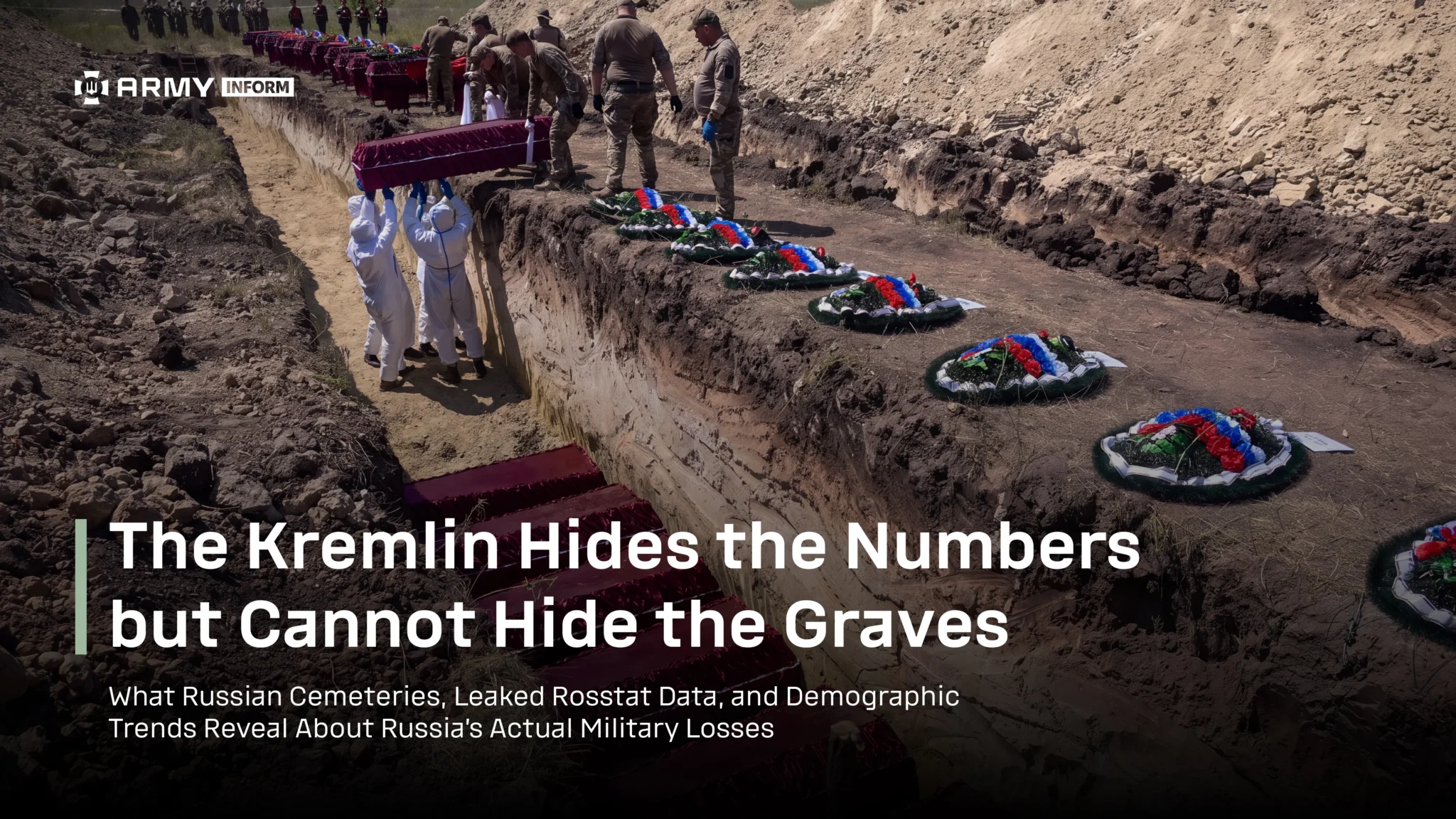
Russia is classifying casualty statistics, restricting access to public records and prosecuting people who photograph military graves.
But open-source data already makes it possible to reconstruct the scale of losses that Moscow is trying to conceal.
The Russian authorities may refuse to disclose the number of people killed in the war against Ukraine, remove statistics from public access and prosecute individuals documenting military burials. However, there is a problem that the Kremlin is finding increasingly difficult to solve through administrative bans: every person killed leaves a trace in government registries, inheritance records, court rulings, local obituaries and cemeteries.
These traces have become the basis for extensive investigations by independent journalists, researchers and the OSINT community. A new data leak from Russia’s Federal State Statistics Service (Rosstat), made public in November 2026, has added another significant body of evidence to the picture already emerging.
According to different methodologies and estimates, the number of Russian military personnel killed since the beginning of the full-scale invasion may be approaching half a million. At the same time, it is essential to distinguish between individually confirmed deaths, statistical estimates and total combat casualties, which also include the wounded and those missing in action.
Why the Kremlin Has Started Hiding Even the Graves
On November 12, Politico published an article with a telling headline: “The Kremlin can hide the death toll. It can’t hide the graves.”
At the center of the report is the case of 48-year-old Yaroslavl resident Nikolai Shcherbakov, who was sentenced in September 2026 to 14 years in a maximum-security penal colony. According to Russian investigators, he photographed and filmed the graves of Russian military personnel and passed the information on to Ukrainian intelligence services. He was charged with treason.
This case does not appear to be an isolated incident. According to Politico, several dozen people suspected of collecting information about military burials have been detained in various Russian regions since the summer. The FSB has begun patrolling cemeteries, while Russian security agencies have warned that photographing military graves can lead to criminal prosecution.
Why have cemeteries attracted so much attention?
Because they are one of the most difficult ways of documenting a war for the authorities to censor. An obituary can be deleted from social media, a local newspaper can be forced to remove a publication, and a statistical report can be classified as restricted information. But physical graves continue to accumulate.
If new military graves appear in a particular cemetery, they can be documented through photographs, satellite imagery, burial dates and comparisons with earlier images. If gravestones bear military ranks, unit designations or dates of death, this information can be cross-referenced with obituaries and other open sources.
In effect, the Russian authorities are attempting to restrict not merely the photographing of cemeteries, but the independent collection of information about the human cost of the war.
The historical parallel is also telling. Politico recalls the Soviet war in Afghanistan, when relatives of fallen soldiers were forbidden from stating on gravestones that their loved ones had died there. Some burials were conducted at night to avoid attracting attention.
Decades later, Russia is once again resorting to practices designed to restrict information about military deaths.
Nearly 413,000 Death Records in the Rosstat Leak: What Has Actually Been Established
One of November’s most significant developments was the hacking of Russia’s state statistical system.
On November 1, 2026, the Belarusian hacking group Cyber Partisans and the Ukrainian group Silent Crow announced that they had gained access to Rosstat’s infrastructure. According to their statements, the breach involved approximately 23 terabytes of information and tens of thousands of compromised computers.
Rosstat confirmed the cyberattack but denied that sensitive data had been stolen.
The hackers subsequently provided journalists with a dataset containing more than 11 million death records. The data was analyzed, among others, by The Guardian and Bloomberg.
According to data published by The Guardian on November 9, the dataset contained 412,576 death certificates in which a link to the war could be identified through relevant cause-of-death codes or textual references to combat operations and military activities.
This is not simply a list of names collected from social media. These are administrative records from a government system containing information about the deceased person’s age, place of residence and place of death.
However, an important methodological distinction must be made here: 412,576 is the number of records linked to the war according to specified criteria, not a definitive count of people killed exclusively on the battlefield. Some deaths may have been associated with the consequences of the war, and different research groups applied different inclusion criteria.
Ukrainska Pravda, citing data from the hackers and Meduza, reported approximately 410,000 deaths associated with combat operations and their consequences. Silent Crow’s broader estimate stood at 450,100 deaths, including additional categories such as non-combat deaths among military personnel.
Cyber Partisans BY, using its own methodology, counted 393,881 deaths.
Thus, the differences between these figures do not necessarily indicate contradictions in the data. They are primarily explained by differences in the categories of deaths included by the researchers.
It is also important to note that The Guardian was unable to independently verify the authenticity of the entire dataset. However, German expert on the Russian economy and statistics Janis Kluge assessed the data as structurally credible and exceptionally informative. He also pointed out that, due to registration delays and unidentified casualties, the actual death toll could be closer to 500,000.
In other words, even this figure may not represent the upper limit.
283,000 Names: How Journalists Count the Dead When the State Remains Silent
Even before the Rosstat leak, independent Russian journalists had established one of the largest systems for documenting military losses.
The Mediazona project, working together with the Russian service of the BBC and volunteers, maintains a name-by-name list of Russian military personnel killed in the war against Ukraine.
As of November 12, 2026, Politico reported that the list contained nearly 283,000 identified names.
The database relies on cross-checking information from open sources. Researchers use:
— Posts by relatives and acquaintances on social media;
— Obituaries published by local administrations and regional media outlets;
— Statements from military units and government authorities;
— Photographs of military graves and memorial plaques;
— Other documents that help verify a person’s identity and confirm their death.
This is an important distinction compared with statistical estimates: every individual included in a name-by-name registry must be identified and verified.
However, this approach also has limitations. Not every family publicly reports a death. Not every service member has an identified grave. Some bodies remain on the battlefield, while certain military personnel are listed as missing for years.
Therefore, a name-by-name list represents the minimum number of documented deaths, not the complete picture.
This is precisely why combining different methods is so important: photographs of graves reveal physical burials, obituaries help identify individuals, and government registries make it possible to detect deaths that relatives have never reported publicly.
Inheritance Records and Court Rulings: How to Find Those Russia Has Left Off Its Public Lists
Another important line of research involves the work of Meduza and Mediazona with Russia’s inheritance case registry.
This is one of the most interesting examples of OSINT because researchers use administrative data that, at first glance, has no direct connection to the war.
The logic is straightforward: when a person who owned property dies, an inheritance case is opened. If the number of such cases among men of a certain age rises sharply compared with pre-war levels, this may indicate excess mortality.
Researchers cross-reference these figures with the name-by-name list of the dead and use the ratio between confirmed deaths and inheritance cases to estimate the overall number of fatalities.
In May 2026, Meduza and Mediazona published another update to their joint study. Their estimate was approximately 352,000 Russian military personnel killed between the beginning of the full-scale invasion and the end of 2025.
Particularly important is the fact that researchers were able to account for another category: military personnel who went missing and were subsequently declared dead by court order.
According to the study, the number of relevant court applications increased from approximately 8,100 per year to 22,900 in 2024 and 79,800 in 2025.
At the same time, more than 52,000 records accumulated in the inheritance registry in which at least six months had elapsed between the date of death and the registration of the inheritance case.
This may be linked to military personnel remaining officially listed as alive or missing for extended periods, even though they had in fact been killed.
Researchers suggest that Russia’s Ministry of Defense used court proceedings to clean military unit rosters of so-called “dead souls” — service members who continued to appear in official records after their deaths.
However, there is an important methodological caveat: some of these deaths cannot be fully independently verified through obituaries or other public evidence. Therefore, the estimate of 352,000 is a statistical reconstruction, not a count of individually confirmed fatalities.
This example demonstrates how important it is to examine not only direct reports of casualties but also the indirect administrative consequences of death.
The Geography of Losses: Who Is Actually Paying the Price of the War Inside Russia?
One of the most important findings from the analysis of the Rosstat leak is the uneven distribution of deaths across Russia’s regions.
According to The Guardian, in Buryatia, Tuva and Zabaykalsky Krai, war-related deaths accounted for approximately one-third of all deaths among men aged 18–49 between the beginning of the full-scale invasion and mid-2024.
By comparison, in Moscow and St. Petersburg, the figure was approximately 10%.
The war does not distribute human losses evenly across Russia’s regions. The heaviest burden falls on more remote and economically weaker territories, where military service may be one of the few available sources of stable income.
For families in poorer regions, signing a contract with Russia’s Ministry of Defense often becomes a financial decision. The state offers substantial enlistment payments, regional bonuses and compensation to the families of those killed.
As a result, a social model is emerging in which a significant share of the human resources used to sustain the war is recruited from territories where economic opportunities are limited.
This does not mean that there are no fatalities in Moscow or St. Petersburg. However, the proportion of deaths among men of the relevant age groups indicates a substantial difference in the war’s impact across regions.
For the Kremlin, this geographical pattern has another consequence: the main burden of the war may remain less visible to residents of the country’s largest political and economic centers, while remote regions lose a disproportionately large share of their male population.
500 Deaths a Day: What the Dynamics of Losses Reveal
Another important indicator is not just the total number of people killed, but the rate at which that number is increasing.
According to an analysis by Janis Kluge cited by The Guardian, the number of Russian military personnel killed exceeded 15,000 per month during several months in late 2024 and throughout 2025.
That is equivalent to approximately 500 deaths every day.
This figure should not automatically be applied to every day of the war: the intensity of combat operations fluctuates, and death registration is subject to delays. Nevertheless, it illustrates the scale of human losses during the most intense periods.
For comparison, in December 2025, the BBC reported that its joint name-by-name list with Mediazona contained nearly 160,000 confirmed names. At the time, journalists estimated that the actual death toll could range from 243,000 to 352,000, based on the assumption that open sources allowed them to identify approximately 45–65% of all deaths.
These figures cannot simply be added to newer estimates: they cover different periods and use different methodologies. However, taken together, they demonstrate how rapidly the scale of documented and estimated losses is changing.
What These Figures Mean for Russia’s Ability to Continue the War
The number of people killed does not, by itself, determine a state’s ability to wage war. To assess that, it is necessary to consider mobilization resources, contract recruitment rates, the number of wounded personnel, the return of service members to active duty, equipment supplies and the capabilities of the military-industrial complex.
Nevertheless, heavy irrecoverable losses have several long-term consequences.
First: the constant need to replenish personnel.
If Russia loses tens of thousands of military personnel every month, it must do more than recruit new people. It must replace those who have been lost, maintain the strength of its units and provide reserves for rotations.
Even high rates of contract recruitment do not automatically guarantee the preservation of training standards or combat effectiveness.
Second: demographic pressure.
The deaths of men of working age affect population structure, the labor market, birth rates and social support for families. This effect may be particularly pronounced in sparsely populated regions, where even a few thousand additional deaths can significantly alter the demographic situation.
Third: growing financial obligations for the state.
The Russian authorities must finance enlistment payments, compensation for the families of those killed, medical treatment for the wounded and social obligations toward veterans.
These expenses do not necessarily trigger an immediate budget crisis, but they compete with other government spending priorities and create a long-term financial burden.
Fourth: the growing social inequality of the war’s human cost.
If men from poorer and more remote regions account for the largest share of fatalities, this may deepen the economic and demographic divide between Russia’s center and its periphery.
Thus, even if the Kremlin remains capable of recruiting personnel, this does not mean the war is not creating mounting structural problems for the Russian state.
What a Comparison of Different Sources Reveals
As of November 13, 2026, several major estimates can be compared.
Separately, The Economist maintains an open model for estimating Russian losses. As of November 13, its central estimate stood at approximately 550,000 deaths, with a range of 378,000 to 801,000.
This is not the result of a direct count of graves or death certificates. The model combines public and leaked estimates, the intensity of combat operations, geospatial data and changes in territorial control. The authors themselves emphasize that the model does not have access to complete data on the actual number of people killed and that its results should be treated with caution.
It is also important not to confuse fatalities with total combat casualties. For example, The Economist’s model estimates total Russian casualties — including both killed and wounded personnel — at approximately 1.738 million as of the same date. This is an entirely different category and cannot be compared with the number of deaths.
The Russian authorities are trying to control not only information about the course of the war but also the memory of its human cost. That is why access to statistics is being restricted, data is being classified, and photographing military graves is becoming grounds for criminal prosecution.
Nevertheless, modern OSINT methods make it possible to reconstruct the picture from fragments: photographs of cemeteries, obituaries, court rulings, inheritance registries, demographic statistics and leaks from government databases.
The most important conclusion is not that there is one definitive figure for Russian fatalities. No such figure currently exists. What matters is something else: different independent methodologies, based on different sources, point to a scale of losses that far exceeds Moscow’s latest official figures.
The Kremlin can conceal statistics, but it cannot erase the demographic consequences of the war, remove every trace of burial or force every family to remain silent.
And every new independent investigation makes the human cost of Russian aggression increasingly visible — even to those in Russia who are being forbidden from looking at these graves.