The EU Tightens Russia’s Financial Blockade: Why New Sanctions Could Hit Oil Revenues and Sanctions Evasion Networks

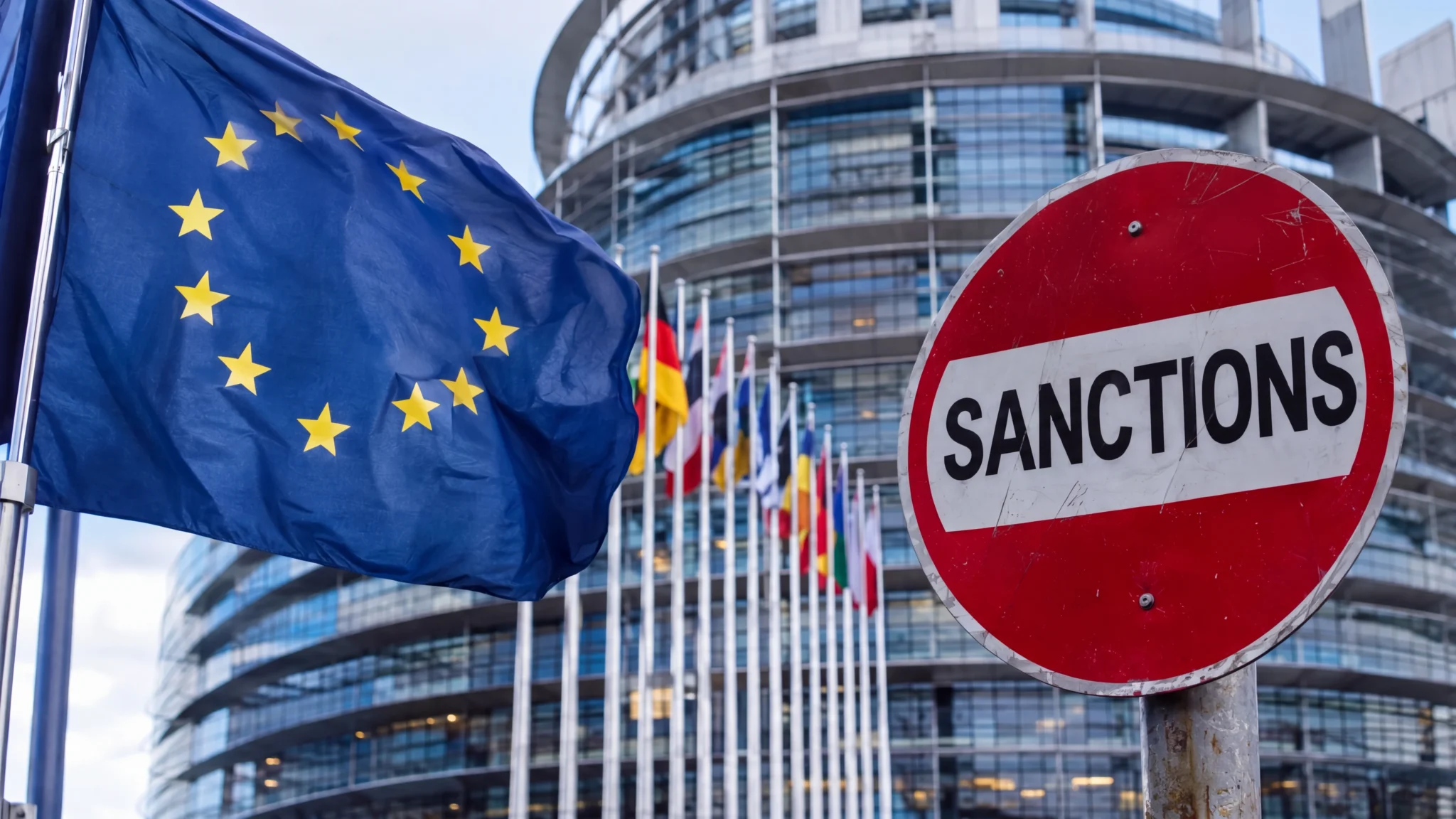
The European Union is preparing new restrictions targeting Russian banks, the energy sector and financial intermediaries.
The goal is to make it harder for the Kremlin to access foreign-currency revenues and finance its war.
The European Union is preparing a new phase of economic pressure on Russia, focusing on two sectors that directly affect the Kremlin’s ability to finance the war: the banking system and energy exports.
Bloomberg has reported on the planned tightening of sanctions. Meanwhile, Reuters, citing statements by European officials, specifies that the European Commission is preparing its 22nd sanctions package against Russia. It is expected to be presented ahead of a special meeting of the European Council on November 26–27, 2026.
The new restrictions are expected to target Russian banks, cryptocurrency transactions, crypto platforms and mechanisms for circumventing sanctions through third countries. Another key area is the disruption of financial channels that allow Russia to continue conducting international transactions despite previous restrictions.
At the same time, the EU is already preparing additional sanctions measures. According to France’s Minister Delegate for European Affairs, Benjamin Haddad, on Monday, November 16, the European Union is expected to approve restrictions targeting another 150 entities and 50 banks. He said that France had submitted most of the relevant proposals.
This distinction is important: these are imminent sanctions decisions, separate from preparations for the next, 22nd sanctions package.
The Banking System: How Russia Is Losing Its Ability to Conduct Transactions with the Outside World
Financial restrictions are about more than freezing the accounts of individual banks or prohibiting cooperation with specific institutions. Their strategic objective is to complicate the entire chain of international transactions through which Russia receives payments for exports, pays for imports and finances foreign economic operations.
After the start of the full-scale invasion, Moscow attempted to restructure its financial infrastructure to reduce its dependence on Western payment systems. To achieve this, it turned to alternative transfer channels, banks in third countries, cryptocurrency platforms and networks of financial intermediaries.
However, these mechanisms do not mean complete financial independence. On the contrary, the more intermediaries involved in transactions, the more dependencies emerge: from the willingness of foreign banks to work with Russian clients to the ability to convert funds and process payments without them being blocked.
The EU’s 21st sanctions package, adopted in July 2026, is a telling example. It introduced restrictions targeting 94 Russian banks and major financial institutions, extended the transaction ban to another 33 Russian credit and financial institutions, and imposed sanctions on banks and cryptocurrency platforms in third countries.
The European Union also introduced a mechanism allowing it to prohibit transactions with any foreign cryptocurrency service provider if that provider is being used by Russia to circumvent sanctions.
Thus, sanctions policy is gradually shifting from isolating individual Russian institutions to targeting the entire infrastructure that enables them to operate beyond Russia’s borders.
For the Russian economy, this means more expensive transactions, greater financial risks and a constant need to find new intermediaries. For the Kremlin’s war machine, it means additional obstacles to receiving funds and purchasing essential goods abroad.
Oil: The Main Source of Foreign-Currency Revenues Remains Vulnerable
Financial pressure is particularly significant when combined with restrictions on the energy sector. Oil and gas remain among Russia’s main sources of foreign-currency revenues, meaning that any obstacles to selling, transporting and receiving payment for these commodities directly affect the Russian budget’s financial capacity.
However, the latest statistics demonstrate how challenging this task remains.
According to the Centre for Research on Energy and Clean Air (CREA), in October 2026, Russia earned an average of €754 million per day from fossil fuel exports. This was 14% more than in September and the highest figure since December 2022.
Oil revenues increased particularly noticeably. Average daily earnings from crude oil exports reached €449 million, up 19% from the previous month. Revenue from seaborne crude oil exports increased by 23%, reaching €352 million per day.
This indicates that Russia is still capable of generating substantial profits from energy exports, despite years of sanctions and restrictions.
At the same time, the increase in revenue should not automatically be interpreted as an increase in physical export volumes. According to CREA, overall fossil fuel export volumes remained approximately unchanged. This means that market price conditions played an important role.
In particular, revenue from Russia’s mineral extraction tax on oil amounted to 979.3 billion rubles in October, 42% more than a month earlier. This was the highest figure since February 2024. CREA links this increase, among other factors, to rising global oil prices amid the war in the Middle East.
In other words, even when sanctions restrict export opportunities, favorable international market conditions can partially offset Russia’s losses.
The Shadow Fleet and Third Countries: Where Sanctions Loopholes Remain
One of the biggest challenges facing sanctions policy is Russia’s ability to change shipping routes, intermediaries and the legal structures behind its export operations.
The so-called shadow fleet plays a particularly important role in this process. It is a network of tankers used to transport Russian oil outside traditional monitoring mechanisms and price-cap restrictions.
According to CREA, in October 2026, 60% of Russia’s seaborne oil exports were transported by tankers already subject to sanctions. Another 37% of the volume was carried by vessels owned by or insured through companies based in G7+ countries.
These statistics reveal an important contradiction: sanctions cover a substantial portion of the tanker fleet, but the mere inclusion of a vessel on a sanctions list does not automatically mean that it ceases operating. Enforcement of restrictions, insurance, servicing and port access remain critical.
Another revealing development is the changing composition of the shadow fleet. Over the course of a year, the number of vessels operating under false flags fell from 112 to 40. At the same time, the share of tankers sailing under the Russian flag increased significantly: in October, 62 such vessels transported 47% of the oil carried by the shadow fleet. A year earlier, that figure stood at just 6%.
This may indicate that Russian logistics are adapting to tighter international oversight: instead of relying constantly on complex schemes involving flag manipulation, an increasing share of shipments is being transferred to vessels directly associated with Russia.
The issue of processing Russian crude abroad also remains important.
In October, refineries in India, Turkey and Brunei that process Russian crude exported €1.6 billion worth of petroleum products to countries that have imposed sanctions. The volume of these shipments increased by 21% in a single month.
In other words, restrictions on direct imports of Russian oil do not eliminate all opportunities for it to reach Western markets after being processed in third countries.
That is precisely why tighter oversight of financial intermediaries, oil traders, refineries and shipping companies may be just as important as introducing new prohibitions directly targeting Russia.
China and India: Why Sanctions Pressure Must Extend Beyond Europe
Another important factor is the geography of Russian energy exports.
After losing a significant share of its European market, Moscow redirected its supplies towards Asia. China and India are the primary destinations.
According to CREA, in October, China purchased €10.7 billion worth of Russian fossil energy resources, while India purchased €6.4 billion worth. For both countries, these were the highest monthly purchase volumes recorded by CREA since it began tracking the data in January 2022.
China accounted for 50% of all Russian crude oil purchases from the beginning of the European import ban through the end of October 2026. India accounted for another 37%.
This explains why European sanctions alone cannot completely deprive Russia of oil revenues simply by restricting trade within the EU.
Moscow has alternative buyers, while importing countries gain the opportunity to purchase raw materials on more favorable terms. However, this reorientation also makes Russia dependent on a limited number of major buyers.
As a result, sanctions pressure on banks, traders, insurance companies and other financial institutions in third countries is becoming one of the key instruments for influencing Russian exports.
How Much Stronger Could the New Restrictions Become?
CREA analysts have also modelled how changes to the price-cap mechanism could affect Russian revenues.
According to their calculations, if the price cap on Russian oil were lowered to $30 per barrel, restrictions on petroleum products were tightened accordingly, and the measures were fully enforced, Russia could have lost €3.4 billion in seaborne oil and petroleum product export revenues in October.
That is approximately one-quarter of the relevant export revenues for the month.
It is important to emphasize that this is a modelled scenario based on the assumption of full compliance with the restrictions, not a figure representing losses already recorded in the Russian budget.
This is where the main problem with the current sanctions system becomes apparent: the effectiveness of restrictions depends not only on how stringent they are, but also on how effectively their implementation is monitored and enforced.
What This Means for Russia’s Ability to Continue the War
The EU’s new sanctions policy demonstrates a gradual shift from targeted restrictions towards attempts to influence entire economic chains that sustain Russian exports and war financing.
The banking sector, cryptocurrency platforms, oil traders, tanker companies and refineries are interconnected elements of a single system.
If Russia finds it increasingly difficult to receive payments for oil, conduct international transfers, insure tankers and find new buyers, the costs of every stage of an export operation increase. Some revenues are lost through discounts, intermediaries, logistics and financial risks.
This does not mean that a new sanctions package will automatically cause the Russian economy to collapse or immediately reduce military spending. Russia retains substantial export capabilities, while global energy prices may temporarily offset some of the impact of sanctions.
However, the systematic tightening of restrictions can narrow the Kremlin’s financial room for maneuver, increase the cost of sanctions evasion and gradually make it more difficult to convert energy resources into funds that can be channelled towards the war.
The key question now is not how many new names will be added to sanctions lists, but whether Europe can shut down the mechanisms that allow Russia to continue earning money from oil, circumvent financial restrictions and use international infrastructure to sustain its wartime economy.