Gasoline as an Indicator of Russia’s Vulnerability: How Ukrainian Strikes on Oil Refineries Are Triggering a Fuel Crisis in Russian Regions

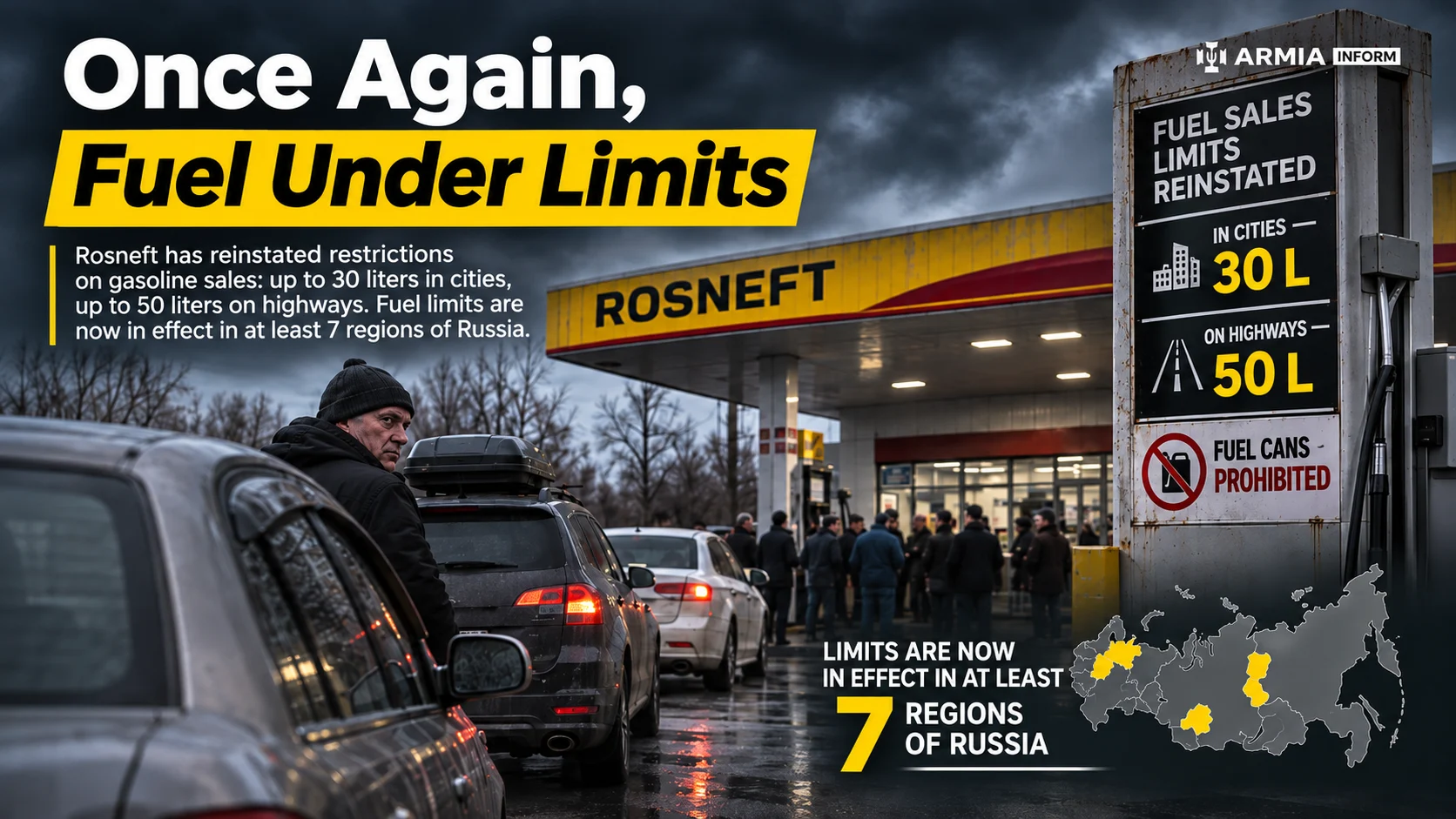
Russia’s Rosneft has reinstated fuel sales restrictions following a new wave of strikes on oil refineries.
The consequences are already being felt in several Russian regions.
Russia’s fuel market is once again facing problems that, just a few weeks ago, the authorities were trying to portray as having been overcome. On November 9, reports emerged that Rosneft had reinstated restrictions on fuel sales at its filling stations. In cities, drivers are allowed to purchase up to 30 litres of gasoline, while on highways the limit is 50 litres. In addition, sales of fuel in containers have been banned in several regions.
The Ministry of Economic Development of Zabaykalsky Krai reported that restrictions had been introduced across all regions where the company operates. However, as of November 10, Rosneft itself had not issued official confirmation of the introduction of uniform nationwide limits. Restrictions have already been reported in at least seven regions: Zabaykalsky Krai, Buryatia, Karelia, Krasnoyarsk Krai, and Novosibirsk, Arkhangelsk, and Penza regions. The Insider reports this.
Significantly, the previous restrictions at filling stations had only begun to be lifted in late October. In other words, Russia’s fuel system had not had enough time to operate normally for any substantial period before a new wave of problems forced the reinstatement of limits.
Strikes on Oil Refineries: From Damage to Individual Facilities to Supply Disruptions
One of the main factors behind the current escalation has been Ukrainian strikes on Russia’s oil refining infrastructure.
According to Reuters on November 9, at least eight major Russian oil refineries had been targeted by Ukrainian strikes over the preceding two weeks. The intensity of the attacks increased after October 30. Among the most recent targets was the Kirishi oil refinery in Leningrad Oblast, which Reuters describes as the second-largest refinery in Russia in terms of capacity.
Earlier reports indicated strikes on the Novokuibyshevsk refinery in Samara Oblast, facilities in Bashkortostan, and the Ryazan and Saratov refineries.
The importance of such facilities lies not only in the value of the damaged equipment. An oil refinery is part of a large production chain that converts crude oil into gasoline, diesel, and other petroleum products. Damage to primary processing units, catalytic cracking units, or other technological components can reduce the output of finished fuel even while oil production continues across the country.
In other words, having large quantities of crude oil does not guarantee that it can be quickly processed into gasoline and delivered to consumers.
This is precisely why the consequences of such strikes can extend far beyond the individual facility. Reduced refining capacity forces companies to change supply routes, redistribute available reserves, seek alternative sources of finished petroleum products, and increase logistics costs.
According to estimates cited by the Financial Times on November 10, between 20% and 35% of Russia’s oil refining capacity may be offline. The publication also reports that Russia has begun importing gasoline by sea, including from Turkey, Morocco, and Egypt.
This is an important indicator of a structural problem: a country that is one of the world’s largest oil producers is being forced to look abroad for finished fuel to supply its own domestic market.
Why the Gasoline Crisis Is Becoming a Problem for Russian Regions
Fuel restrictions are not merely an inconvenience for motorists. They directly affect everyday economic activity.
Fuel is essential for freight transportation, agriculture, construction, industrial operations, and both public and private transport. When supplies become unstable, businesses are forced to revise their logistics, spend more time refuelling, and factor additional costs into the prices of goods and services.
Remote regions may be particularly vulnerable, as their transport accessibility depends on road freight and alternative supply routes are limited.
The situation in Zabaykalsky Krai demonstrates the scale of the problem. According to the local outlet Lyudi Baikala on November 10, the region had more than 26,000 tonnes of fuel remaining, including reserves. According to the regional Ministry of Economic Development, these stocks should last approximately one month. At the same time, an additional 10,000 tonnes of fuel are already being sent to the region.
This means that local authorities are being forced not only to restrict sales but also to arrange additional supplies to maintain the region’s normal functioning.
Another important indicator is the recurring nature of the crisis. Restrictions were already introduced in the summer of 2026. At that time, supply problems were reported in various parts of Russia, including the south, the Volga region, and central regions. Some oblasts introduced limits on gasoline sales, while local authorities were forced to intervene in the operation of the fuel market.
Now, following a brief period of stabilisation, the situation is repeating itself. This indicates that previous measures helped temporarily balance supply but failed to eliminate vulnerabilities in Russia’s oil refining system.
What Russians Themselves Are Saying: From Queues at Filling Stations to Fears of a New Shortage
The reaction of Russian residents to fuel restrictions shows how a nationwide problem manifests itself in everyday life.
Business FM spoke with drivers from Karelia, Arkhangelsk Oblast, and Krasnoyarsk Krai following reports that fuel limits were being reinstated.
Vladimir, a resident of Petrozavodsk, said that during the previous fuel crisis, people had to wait in queues at filling stations for two to three hours. According to him, fuel shortages even affected the tourism industry: some people cancelled trips to Karelia because they were unsure whether they would be able to refuel their vehicles.
A resident of Arkhangelsk Oblast, Alexey Nesterenko, an automotive expert with the Popular Front movement, also reported that, in his assessment, prices had increased by approximately 1.5 to 2 roubles following the previous crisis. He attributed the stabilisation of the situation, among other factors, to restrictions on selling fuel in containers.
In Krasnoyarsk, news of the reinstated limits came as a surprise. Business FM correspondent Alexey Fedoreyev said that local residents had already begun to feel that the situation was returning to normal: gasoline prices were falling, queues at some filling station chains had disappeared, and restrictions had been lifted.
However, the new measures have once again cast doubt on the stability of fuel supplies.
There are also other indications of public dissatisfaction. According to The Insider, residents of Zabaykalsky Krai complained in the comments sections of local authorities’ announcements about limits that, at some filling stations, amounted to just 30 litres, as well as another increase in fuel prices — by almost two roubles per litre.
Thus, Russian public reaction is not uniform at this stage. Some drivers have yet to experience direct supply disruptions, while others remember the previous queues and already fear a repeat of the situation. However, even in the absence of widespread panic buying, the very fact that restrictions have been reinstated after being lifted points to market instability.
For the Russian authorities, this creates an additional challenge: they must simultaneously explain the reasons for the restrictions to the public, keep prices under control, and guarantee uninterrupted fuel supplies to the regions.
How This Affects Russia’s Ability to Continue the War
The most important aspect of the fuel crisis for Ukraine is not the number of litres Russian motorists are allowed to purchase, but the overall economic impact of systematic disruptions to the oil refining industry.
Russia’s war machine depends on large-scale logistics. Fuel is essential for military vehicles, freight transportation, military infrastructure, aviation, and the supply of military units. Therefore, the oil refining industry is important not only for the civilian economy but also for sustaining the country’s military capabilities.
At the same time, it is important to distinguish between civilian and military supply chains. There is no basis for claiming that the introduction of limits at commercial filling stations automatically means that Russian troops are experiencing fuel shortages. The state can prioritise military requirements, use reserves, change supply routes, and redistribute petroleum products.
However, this very redistribution places an additional burden on the economy.
If some resources have to be redirected to supplying the domestic market, compensate for lost refining capacity through imports, repair damaged facilities, and maintain logistics infrastructure, this increases costs for the state and energy companies.
Furthermore, instability in oil refining complicates the fulfilment of export commitments. Reuters points out that the new wave of Ukrainian attacks could also create problems for the fulfilment of agreements concerning Russian diesel fuel supplies to foreign markets.
Another point is important in this context: Russia is attempting to supply its domestic market, preserve export revenues, and sustain its wartime economy simultaneously. Disruption to one element of this system forces the country to find resources to compensate for the losses in other areas.
In other words, the impact of Ukrainian strikes does not necessarily manifest itself as an immediate halt to fuel supplies to the front. It can be cumulative: through more expensive logistics, additional repair costs, imports, resource redistribution, and reduced economic flexibility.
Why This Matters for Ukraine
Ukraine is dealing with a state that uses revenues from energy exports to sustain its economy and finance its aggression. Therefore, targeting oil refining infrastructure is one way of reducing Russia’s ability to directly meet its economic and military needs.
It is important to understand the difference between oil production and oil refining. Russia may continue extracting oil, but if part of its refining capacity is offline, problems arise with the production of finished petroleum products. This forces the country to choose between repairing facilities, redistributing reserves, reducing exports, and purchasing finished fuel abroad.
Each of these options comes at a cost.
For Ukraine, the important outcome is not merely the physical damage to an individual refinery, but also the need for Russia to continuously spend resources restoring a system that sustains its domestic economy and military requirements.
The psychological and societal impact is also significant. For years, the Russian authorities have promoted the perception that the country is economically resilient and capable of continuing the war without any substantial impact on the everyday lives of its population. However, recurring fuel restrictions, queues, rising prices, and supply problems in the regions demonstrate that the consequences of the war and Ukraine’s long-range strikes are increasingly being felt inside Russia itself.
This does not necessarily mean an automatic rise in anti-war sentiment or political instability. However, such problems create additional grounds for dissatisfaction with local authorities and the federal government, particularly when restrictions return after official statements that the situation has normalised.
Thus, the reinstatement of fuel sales limits in Russia is not simply a local problem affecting filling stations. It is one of the indicators of how Ukrainian strikes on oil refining infrastructure are affecting the economic resilience of the aggressor state.
Ukraine does not necessarily have to achieve a complete shutdown of Russian oil refining to generate a strategic effect. It is enough to impose continuous costs on the Russian system, force it to restore damaged capacity, alter logistics, and redistribute resources. In a prolonged war, a state’s ability to sustain its economy and war machine without interruption is no less important than the quantity of weapons on the battlefield.