Ukrainian Strikes on Russian Oil Refineries: Russia’s Oil Processing Falls by a Third as the Aggressor’s Fuel System Loses Resilience

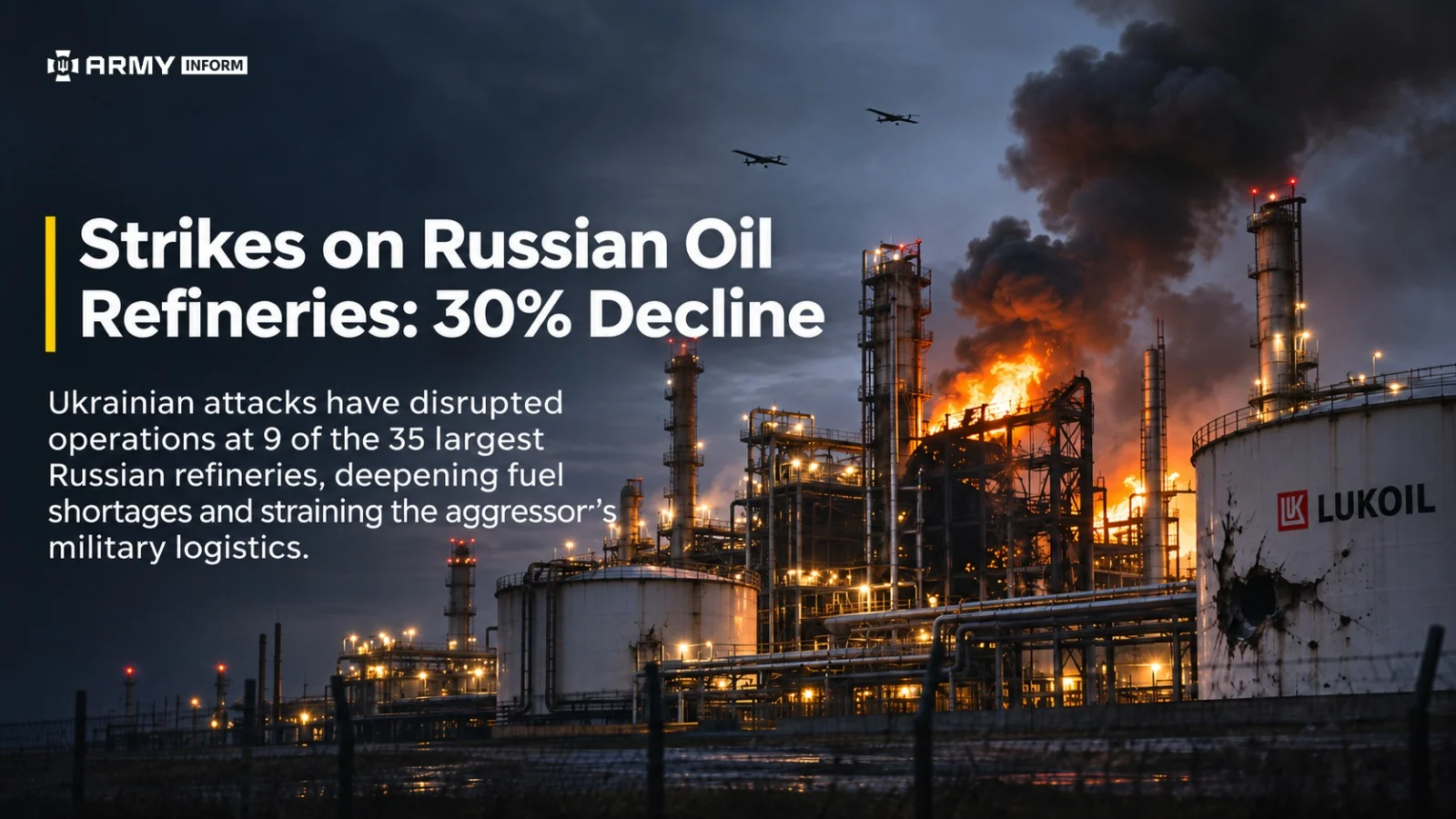
Ukraine’s campaign of long-range strikes against Russia’s oil infrastructure is becoming a systematic instrument of economic attrition against Russia.
This is no longer simply a matter of isolated fires at oil refineries. It is a sustained effort to disable production capacity, disrupt fuel logistics, and increase the strain on the remaining elements of Russia’s oil refining system.
According to Reuters on November 10, Ukrainian attacks disrupted the operations of 9 of Russia’s 35 largest oil refineries in just the past week. Two industry sources cited by the publication estimate that Russia’s actual oil refining output may have fallen by as much as 200,000 tonnes per day. Overall, this represents a decline of approximately 30% compared with the level of processing recorded by Russian facilities at the end of October.
These are no longer isolated tactical successes. They are signs of large-scale pressure on one of the key industries underpinning the Russian economy, export revenues, and military machine.
Nine Refineries in One Week: What the Geography of the Strikes Reveals
The scale of the latest wave of attacks matters not only because of the number of facilities hit, but also because of which specific facilities have come under attack.
According to Reuters, the Ukrainian drone campaign, which resumed in late October, has disrupted the operations of nine of Russia’s 35 largest refineries. Among the affected facilities are refineries in Ryazan, Yaroslavl, and the Volga region. Separately, on November 9, the Kirishi refinery in the Leningrad region — one of the country’s largest oil refining complexes — was attacked.
It is important to understand that a refinery’s nominal capacity is not the same as the volume of oil it actually processes. Therefore, assessing the consequences solely on the basis of facilities’ rated capacities would be inaccurate. What matters far more is whether primary processing units have been shut down, whether secondary processing units have been damaged, and how quickly a facility can resume operations.
This is precisely where Ukrainian strikes are creating the greatest problems for the Russian system.
According to industry sources cited by Reuters, the facilities hit since late October have a combined nameplate capacity of approximately 300,000 tonnes per day. The actual reduction in refining throughput is estimated at up to 200,000 tonnes per day.

Why Damage to a Single Refinery Can Have Consequences for Months
An oil refinery is not a single large storage tank that can be extinguished, repaired, and restarted the following day. It is a complex technological facility in which dozens of processing units operate as an integrated system.
Primary processing separates crude oil into fractions. However, producing marketable gasoline, diesel fuel, and aviation kerosene also requires secondary processing units, including catalytic cracking, hydrocracking, reforming, and hydrotreating units.
And it is damage to these components that can cause the most prolonged disruptions.
In its September analysis of Russia’s oil refining industry, the International Energy Agency (IEA) highlighted a shift in the nature of Ukrainian attacks. Ukraine is increasingly targeting not only primary processing units but also technological units responsible for producing higher-quality fuels.
According to IEA analysts:
- Minor damage to primary processing units can be repaired within one to two weeks;
- Repairs to severely damaged complex secondary processing units can take an average of six to eight months;
- Damage to such components can restrict production even when parts of a refinery formally remain operational.
In other words, Russia’s problem is not merely how much oil it cannot process today. It is also how long it will take to restore production to its previous level.
Russia Can No Longer Offset Its Losses Without Consequences
One of the main problems facing Russia’s oil refining industry is the uneven geographical distribution of its production capacity.
The Kremlin is attempting to compensate for refinery shutdowns by relying on facilities located farther from the Ukrainian border. However, this approach has its limitations: petroleum products must not only be produced but also delivered to consumer regions, ports, military bases, and export terminals.
According to data released by Ukrainian military intelligence on November 5, as of the end of September, 15 of Russia’s 38 major oil refineries had been completely shut down, while another 12 had significantly reduced production. Combined processing volumes at these facilities had fallen by 55.4% compared with the beginning of the year.
The facilities that have experienced shutdowns or operational restrictions include the Yaroslavl, Kirishi, Ryazan, Moscow, and Perm refineries. Together, they account for approximately one-third of Russia’s oil refining capacity.
At the same time, Russian facilities in more remote regions are attempting to increase production. In September, the Omsk, Achinsk, Khabarovsk, and Mari refineries processed a combined 906,000 barrels of oil per day — 147,000 barrels more than at the beginning of the year.
However, this does not mean Russia can shift production eastward without incurring costs. The distance from major consumption centers, shortages of railway tank cars, and limited availability of road fuel tankers complicate the redistribution of petroleum products.
In other words, even if Russia has crude oil available for extraction, that does not guarantee it can process it into the required fuels in time and deliver them where they are needed.
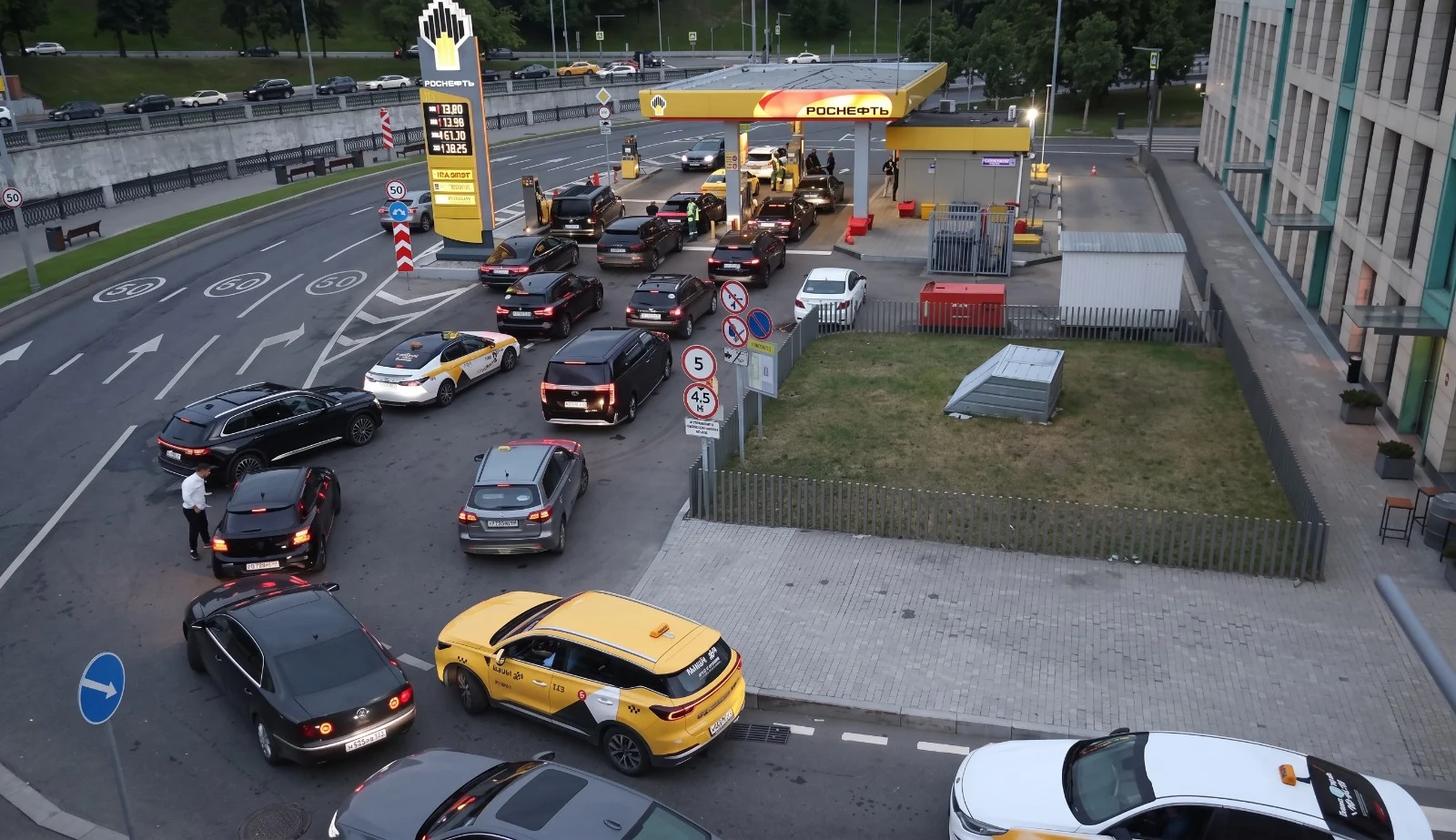
The Consequences Are Already Extending Beyond Refineries: Fuel Shortages and Sales Restrictions
The most tangible indicator of the effectiveness of Ukraine’s campaign is not just the extent of damage to refineries, but also the way production problems are beginning to affect Russia’s domestic market.
On November 9, Hydrocarbon Processing reported the reintroduction of fuel sales restrictions in at least six Russian regions.
In particular:
- Karelia: Certain Rosneft gas stations introduced limits of up to 30 liters of gasoline and 50 liters of diesel. Sales of fuel in portable containers were prohibited.
- Buryatia: Similar restrictions were introduced at Rosneft gas stations in Ulan-Ude.
- Zabaykalsky Krai: Sales restrictions were also reported.
- Nizhny Novgorod Region: A 40-liter-per-vehicle limit was reinstated, along with a ban on sales in portable containers and an odd-even system.
- Penza, Arkhangelsk, and Krasnoyarsk regions: Fuel sales restrictions were reported.
These measures demonstrate that the problem is no longer confined to individual facilities. It is affecting fuel distribution and the everyday lives of people across Russian regions.
At the same time, it is important not to overstate the situation: there is currently no basis for claiming that all of Russia has run out of gasoline. Supply has normalized in some regions, and retail prices have even declined. Nevertheless, the reintroduction of limits amid a new wave of attacks points to the system’s vulnerability and its lack of sufficient resilience reserves.
One particularly interesting development is the divergence between retail and exchange prices on the Russian market. According to ECOMHUB monitoring data for November 9, the average retail price of gasoline declined at the beginning of the month, while exchange quotations for AI-92 and AI-95 gasoline began rising again.
This may indicate that the retail market is still operating for some time on the basis of previously accumulated stocks and established supply channels, while the wholesale segment responds more quickly to the risk of further disruptions.
Therefore, the absence of a sharp price increase at every gas station does not mean that the oil refining industry is free of problems.
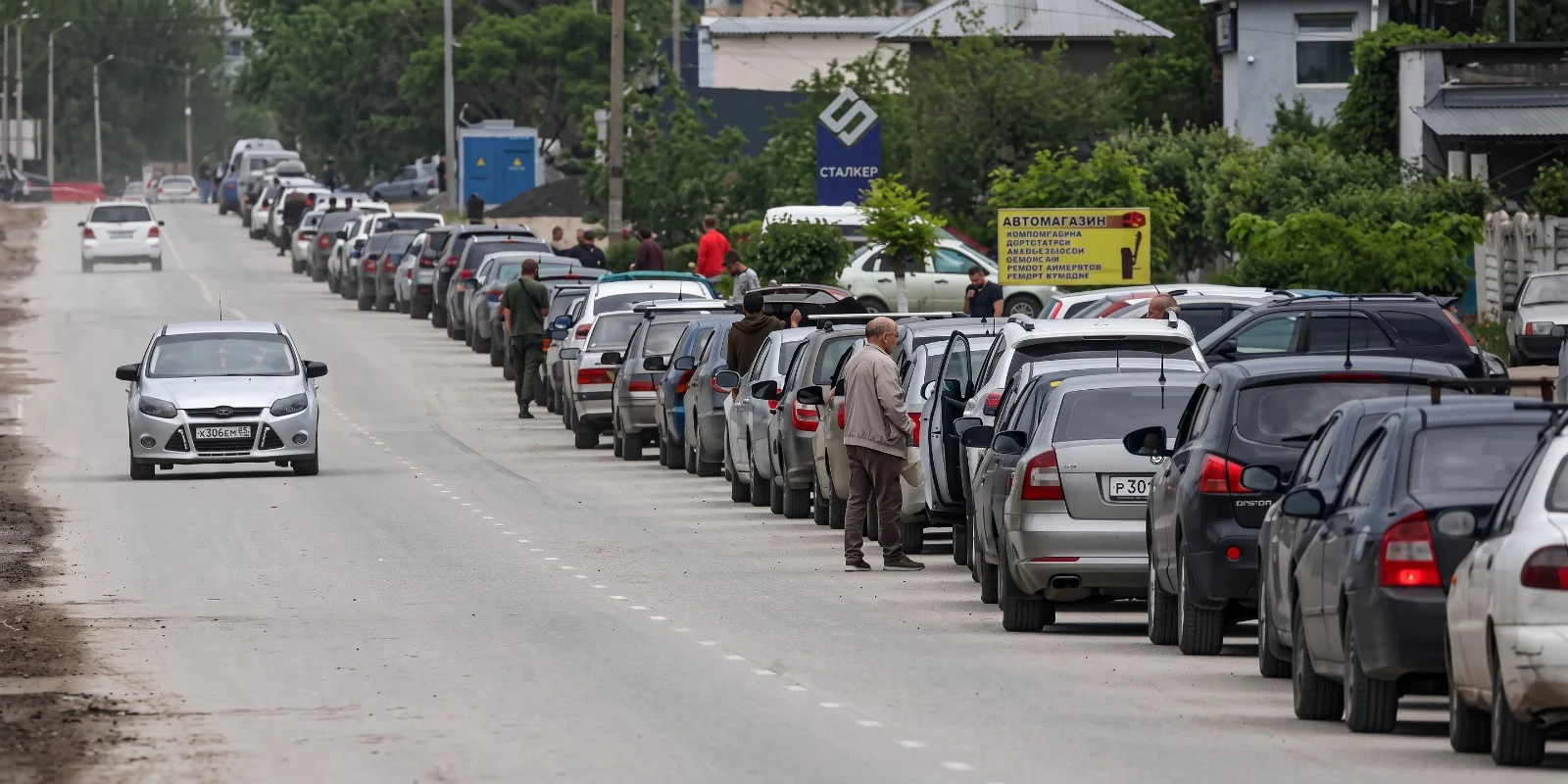
Striking Refineries Also Means Striking Russia’s Military Logistics
The oil refining industry has a dual role for Russia. It supplies the civilian market, but it is also part of the infrastructure without which the country cannot sustain full-scale military operations.
Diesel fuel is essential for tanks, armored vehicles, trucks, engineering vehicles, generators, and logistical transport. Aviation fuel is required for combat and transport aircraft. Gasoline is used by numerous motorized military units and support vehicles.
Consequently, a reduction in petroleum product output creates additional risks for Russia’s military system.
This does not mean that an attack on a single refinery will automatically leave the Russian army without fuel at the front. Military requirements can be met through existing reserves, centralized distribution, the involvement of other refineries, and imports of certain components.
However, every reduction in the available supply of diesel and aviation fuel increases the burden on the remaining supply system.
The position of the International Energy Agency is particularly telling. In its September analysis, the organization noted that declining Russian production of diesel and gasoil was already affecting international middle distillate markets. During the first eight months of 2026, global seaborne exports of gasoil and diesel fuel fell by 10% compared with the same period of the previous year.
The IEA also noted that Russia had been forced to introduce export restrictions on gasoline, aviation fuel, and diesel. For a country that traditionally exported a significant share of its diesel production, this represents a substantial shift in its economic model.
In other words, the consequences of Ukrainian strikes extend beyond Russia’s domestic market: they affect the Russian Federation’s ability to meet its export commitments and maintain stable supplies to foreign markets.
What Russians Themselves Are Saying: An OSINT Analysis of Telegram Reactions
Another important area of this research is the reaction of Russian society to the consequences of the strikes. After all, official Russian propaganda may describe any attack as unsuccessful, report dozens of intercepted drones, and conceal damage. Regional Telegram communities, however, are forced to discuss tangible everyday consequences: queues at gas stations, the unavailability of certain gasoline grades, sales restrictions, and rising fuel costs.
Several particularly interesting studies make it possible to assess these reactions not through isolated emotional posts, but by examining large datasets.
In October 2026, Detector Media published a study analyzing 5,000 posts from a dataset of 37,657 publications posted by 379 Russian and pro-Russian Telegram channels with audiences of at least 10,000 subscribers.
The main findings were:
- 11% of the analyzed posts mentioned the economic consequences of Ukrainian strikes.
- The possibility that Ukrainian attacks could force Russia to end the war was discussed in fewer than 2% of publications.
- Propaganda posts increasingly acknowledge the effectiveness of Ukrainian strikes against Russian infrastructure.
- At the same time, damage to oil refineries is used to justify calls for stronger air defenses, industrial mobilization, and further strikes against Ukraine.
One finding by the researchers is particularly revealing: economic and everyday hardships receive approximately 12 times more attention than the question of whether Ukrainian strikes could force Russia to end its aggression.
This is an important distinction. Ukrainian strikes are creating material hardships for Russians, but this does not automatically turn them into an anti-war audience.
In August, analysts from Join Ukraine published a study examining whom Russians blame for the fuel crisis.
The monitoring covered approximately 950 active regional communities across all federal subjects of the Russian Federation.
Between June and July, the researchers recorded approximately 24,000 publications about the fuel crisis and more than 130,000 comments on them.
The intensity of discussions increased approximately 40-fold compared with April levels.
Interestingly, Russians did not always blame Ukraine directly. In everyday discussions, complaints were often directed at local authorities, the government, oil companies, and the fuel distribution system.
This means that the consequences of Ukrainian attacks are gradually turning into an internal socioeconomic problem for Russia, for which local residents are demanding accountability from their own authorities.
Novaya Gazeta Europe: Nearly 40,000 Comments About Gasoline Shortages
In July, the publication released the results of an analysis of data concerning the fuel crisis on Russian Telegram.
Between May 1 and June 24, approximately 235,000 messages were collected from 45,000 groups and chats. After cleaning the dataset, researchers identified nearly 40,000 comments about gasoline shortages and closed gas stations.
The largest number of complaints came from occupied Crimea, Moscow, Krasnodar Krai, Rostov Region, and Moscow Region.
The most common topics included:
- The unavailability of certain gasoline grades;
- Closed gas stations;
- Limits on the amount of fuel that could be purchased in a single transaction;
- Queues at gas stations;
- Rising prices and everyday inconveniences.
This is no longer simply informational noise surrounding the attacks. These are documented reactions from tens of thousands of users.
Why Russia Is Finding It Increasingly Difficult to Restore Damaged Facilities
Another important factor is the technological dependence of Russia’s oil refining industry.
Repairing an oil refinery is not simply a matter of having money and workers available. Modern refining complexes use sophisticated equipment, technological components, and control systems, some of which depend on foreign manufacturers.
Sanctions pressure makes it more difficult to obtain certain components and find alternative suppliers.
The IEA points out that Russian facilities are attempting to sustain production by postponing scheduled maintenance, bringing previously mothballed units back online, and accelerating restoration work.
However, this approach has a downside.
When refineries operate with deferred maintenance and damaged equipment must be repaired continuously, the risk of recurring failures and prolonged shutdowns increases.
This is particularly true when the same refinery is attacked repeatedly.
According to the IEA, some Russian refineries have been attacked up to 15 times since the beginning of the full-scale war. This means Russia is forced to spend resources not on modernizing the industry or increasing production, but on constantly bringing already damaged capacity back online.
This is one of the main advantages of a systematic campaign: even after an individual facility has been restored, it remains vulnerable to another strike.
OSINT Cross-Check: What Is Confirmed and What Remains an Estimate
For an objective assessment, it is important to distinguish between several indicators that are often mistakenly combined into a single figure.
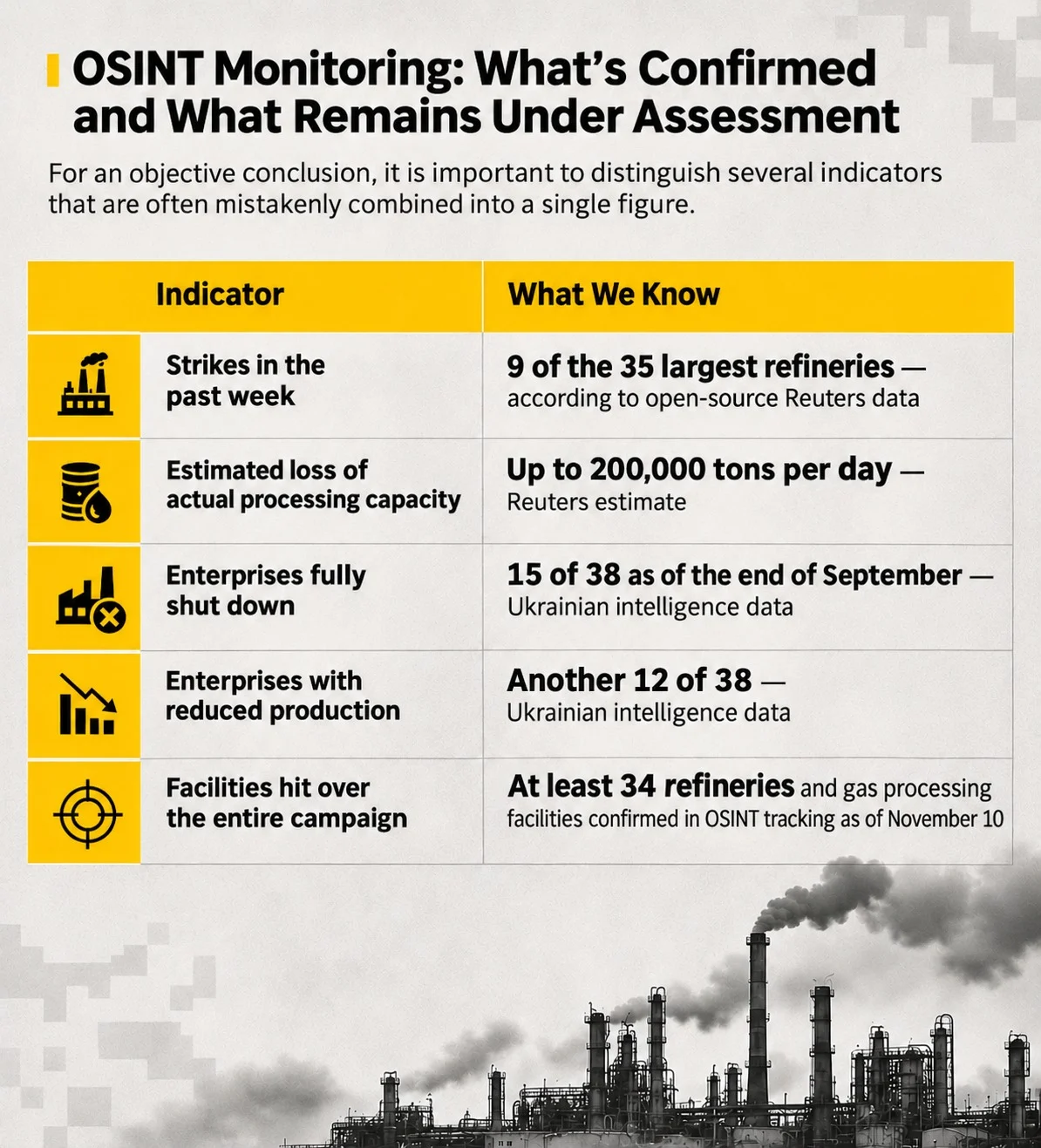
It is also worth mentioning the OSINT project The Refinery Ledger, which systematically documents the geographical distribution of Ukrainian strikes against Russia’s oil refining infrastructure.
According to its data, more than 180 strike incidents involving 34 Russian oil refineries and gas processing facilities have been recorded since March 2024. The geographical coverage of the strikes spans seven Russian macro-regions, while the maximum recorded strike depth reaches approximately 2,469 km.
One important detail: the project’s authors note that estimates of the share of disabled capacity vary depending on the methodology used. This is because damage to an individual processing unit, a complete refinery shutdown, and a reduction in actual refining throughput are three different indicators.
For this reason, the figure of 200,000 tonnes per day should not automatically be interpreted as permanently lost or irreversibly destroyed capacity. It is an estimate of the current reduction in refining throughput, which may change depending on repairs and subsequent attacks.
Ukrainian Strikes Have Turned Russia’s Oil Refining Industry Into a System That Is Constantly Losing Resilience
The effectiveness of Ukraine’s campaign against Russian oil refineries should not be measured by the number of fires visible in satellite imagery or the number of reports about intercepted drones.
The main criterion is how long Russia can maintain the normal operation of its oil refining system in the face of repeated strikes.
As of November 11, 2026, there are several indications that Ukraine’s strategy is working.
- The scale of production disruptions has become so significant that Reuters, citing industry sources, estimates the reduction in actual refining throughput at up to 200,000 tonnes per day. This represents approximately 30% of the refining level recorded at the end of October.
- Russia is being forced to use administrative restrictions to stabilize its domestic market, reinstate fuel sales limits, and restrict exports of certain petroleum products.
- Relocating production to facilities in remote regions cannot fully compensate for the losses. The problem lies not only in production capacity, but also in logistics, distribution, and fuel delivery.
- Sanctions are making it more difficult to repair and replace sophisticated equipment, while repeated strikes prevent facilities from returning to stable production cycles for extended periods.
- The consequences are being felt not only by oil companies, but also by Russian regions, businesses, the transport system, and consumers. This creates additional domestic economic pressure on the Kremlin.
Can we already speak of the complete collapse of Russia’s oil refining industry? No. Russia retains significant production capacity, reserves, and the ability to redistribute resources. However, it is fair to speak of a substantial reduction in available refining capacity, systemic instability, and an increasing cost of maintaining the industry.
And most importantly, Ukraine is forcing Russia to spend increasingly more resources restoring what it considered secure only yesterday.
For the Kremlin, oil refining is not merely a business. It is fuel for the army, logistics, aviation, the economy, and export revenues. Therefore, systematically disabling these facilities is not simply a matter of striking industrial targets. It is a sustained narrowing of the resource base that Russia relies on to continue its war against Ukraine.