Outmatched on Paper, Lethal in the Field: How Ukrainian Forces Systematically Hunted Moscow’s Armor

The Iron Graveyard: How Ukraine Crippled Nearly 1,000 Russian Armored Platforms in 90 Days.
A summer of intense frontline combat has extracted an unprecedented mechanical toll on invading Russian forces.
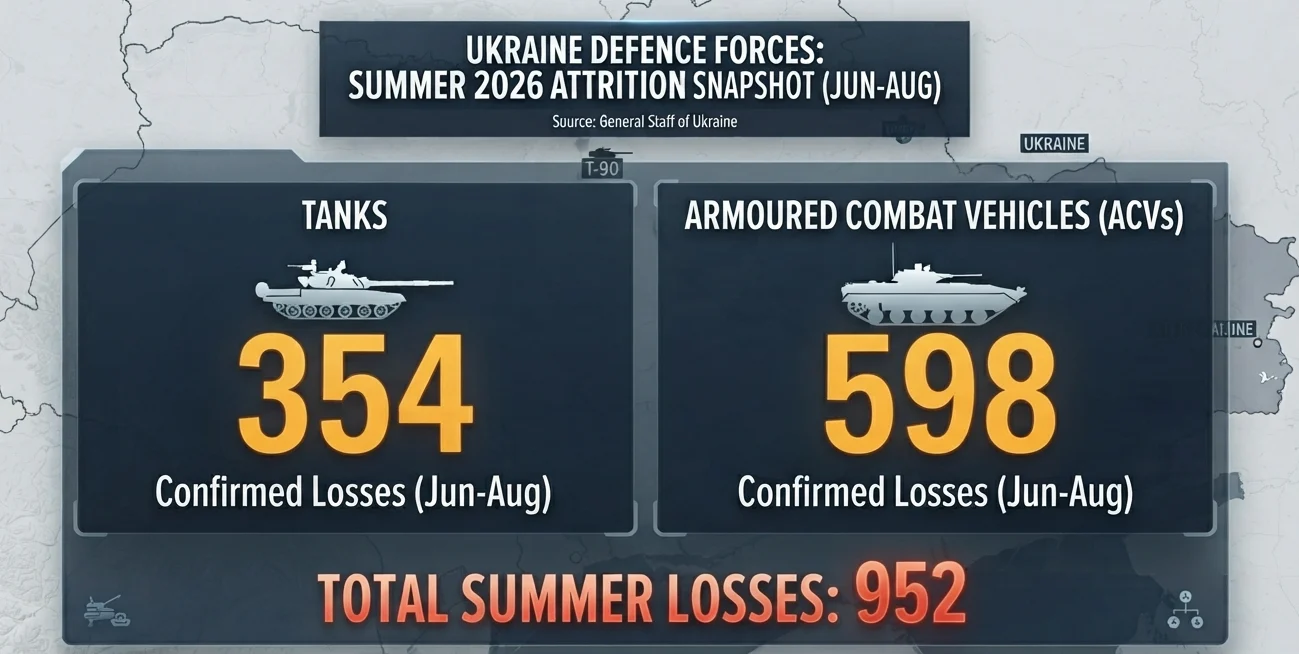
According to official figures released by the General Staff of the Armed Forces of Ukraine, Ukrainian defenders struck 952 enemy tanks and armored combat vehicles across the three summer months of 2026 alone.
The tally includes 354 destroyed or disabled battle tanks and 598 armored personnel carriers and fighting vehicles.
Behind these numbers lies a stark operational reality: Russia’s mechanized momentum is being systematically dismantled at a pace that vastly outstrips Moscow’s industrial replacement capacity.
The Breakdown: A Brutal Summer Campaign
The summer statistics represent an intense spike in vehicle engagements along eastern and southern axes.
The 952 platforms struck between June and August represent almost half of Moscow’s entire losses for the year.
Since the beginning of 2026, Ukrainian forces have recorded strikes on:
-
836 total tanks
-
1,415 armored combat vehicles (ACVs)
-
2,251 total heavy maneuver systems neutralized since January
These losses underline the continuing failure of mechanized assault doctrine against modern, sensor-saturated kill zones.
The Anatomy of the Kill Zone
The scale of vehicle destruction highlights how profoundly the frontline has transformed.
Mass armored charges are no longer viable. Ukrainian strike groups—relying on layered defenses of first-person-view (FPV) attack drones, precision loitering munitions, and remote anti-armor minefields—are intercepting Russian columns long before they can close within direct-fire range.
Infantry fighting vehicles attempting to transport assault elements to contested treelines are routinely tracked from the moment of staging.
The result is a bottleneck where heavy armor serves less as a breakthrough tool and more as an exposed target for decentralized drone units.