Ukraine’s oil strike campaign: a systematic demolition of Russia’s war economy

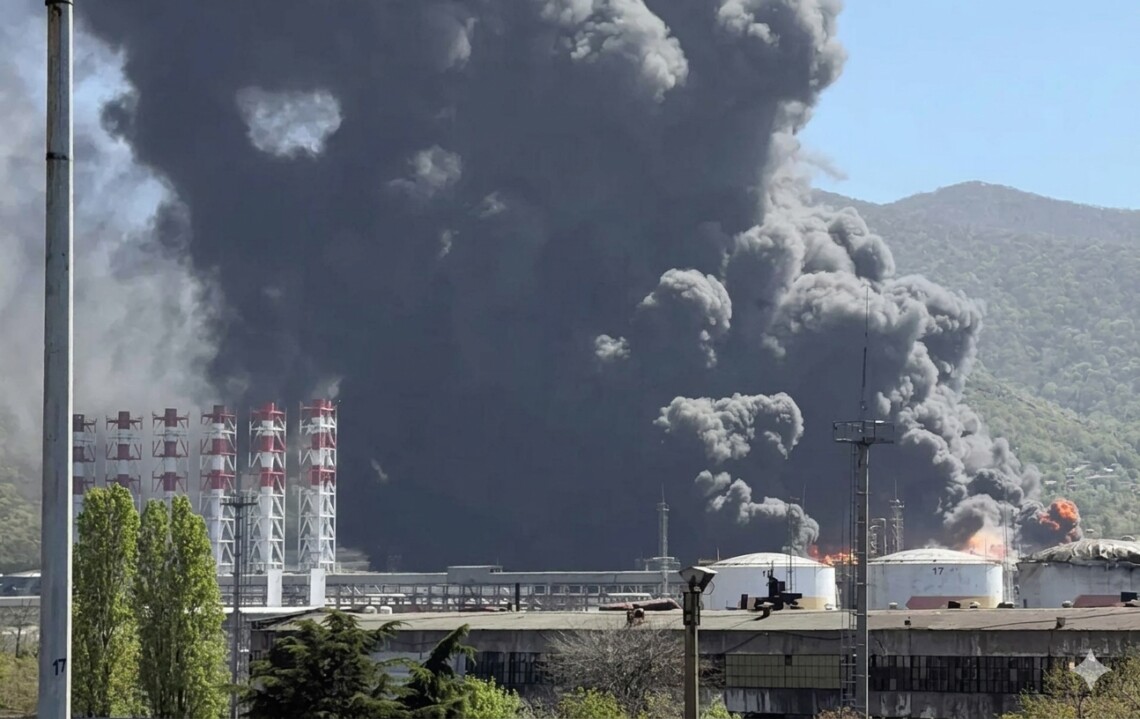
In May 2026, Ukraine's Defence Forces delivered 40 confirmed strikes against Russian oil infrastructure.
In May 2026, Ukraine’s Defence Forces delivered 40 confirmed strikes against Russian oil infrastructure — the highest monthly total recorded since the beginning of the full-scale war. The figure is not final: additional strikes are expected to be confirmed by Ukraine’s military in the coming days.
The number marks more than a statistical milestone. It reflects the maturation of a campaign that has been building in intensity, range, and doctrinal sophistication since January 2026 — a campaign whose effects are now visible not only in satellite imagery of burning refineries, but in Russian government fuel rationing orders, export bans, and a defence budget cut that has no precedent in four years of full-scale war.
The architecture of the campaign
From January through May 2026, the intensity of Ukrainian strikes on Russian oil infrastructure has already exceeded the total recorded for the entire year 2024. Bloomberg designated April 2026 a record month for successful attacks on Russian oil infrastructure — a record subsequently broken by May.
Analysis of the strike geography reveals a deliberate and expanding operational logic. Of the 30 confirmed strikes in April alone, 22 fell within a 900-kilometre radius of Ukraine’s border — the operational range of Ukrainian drone systems including the FP-1, FP-2, February, and Bars platforms. This zone encompasses the bulk of Russia’s accessible refining capacity and has effectively been placed under systematic pressure.
The more significant trend, however, is the rapid growth in strikes beyond 1,000 kilometres. Combining April and May data, Ukrainian forces conducted 18 confirmed long-range strikes — meaning one in every four attacks now reaches deep into Russian territory. The combined operational radius of the campaign, when all confirmed strike locations are mapped, has reached 1,500 kilometres from Ukraine’s state border.
Polish open-source researchers calculated the most frequently struck facilities: the Ryazan and Saratov refineries, each hit 15 times; the Tuapse and Ilyich plants, struck 13 times each.
Case study: the Tuapse operation
The Tuapse Oil Processing Plant in Krasnodar Krai represents the most extensively documented example of how Ukraine plans and executes multi-phase strikes against high-value oil infrastructure.
Tuapse is not a single facility. It functions simultaneously as an oil processing plant, a storage complex, and an export terminal — and it is the only Rosneft facility located on the Black Sea coast. Every tonne of crude processed there generates foreign currency revenue for the Russian state, a portion of which flows directly into financing the war against Ukraine.
Ukraine did not strike Tuapse immediately. Over a two-week period preceding the main attack, Ukrainian forces conducted a systematic reconnaissance and air defence suppression campaign across the surrounding region.
On April 6, Ukrainian drones struck two major ports in Novorossiysk simultaneously, effectively halting cargo and oil export operations. On April 9 and 11, two strikes targeted a Crimean pumping station that supplies raw materials to the Novorossiysk port. On April 11, the Hvardiyske oil depot was struck. On April 15, the Hlybokyi Yar and Oktyabrsky facilities were hit — all in geographic proximity to Tuapse.
Each of these preliminary strikes served a dual operational purpose: direct infrastructure degradation and intelligence collection. Ukrainian forces were mapping air defence radar positions and identifying coverage gaps in preparation for the main strike package.
On April 16, the primary strike on Tuapse was executed. It was followed by additional strikes on April 20, April 28, and May 1 and 27. The fires burned for three days. Smoke spread across an area of approximately 300 kilometres.
The Washington Post subsequently calculated the economic damage: strikes on Tuapse cost the Kremlin an estimated five billion dollars, with an additional two billion in secondary losses.
The targeting logic: what burns and why
Understanding the effectiveness of Ukraine’s strikes requires understanding what is being targeted.
A modern oil refinery is an enormously large facility. The Ryazan Refinery — one of Russia’s three largest plants and the primary fuel supplier for the Moscow region — covers approximately nine square kilometres, equivalent to 20 Vatican Cities or 1,300 football pitches. Destroying such an installation entirely would require a sustained campaign measured in years.
Ukraine’s approach is more precise and more efficient. The critical targeting node at any refinery is the atmospheric vacuum distillation unit — known by its Russian abbreviation AVT. These are the primary processing installations that convert crude oil into usable fuel products. Without functioning AVTs, primary refining is impossible regardless of the condition of surrounding infrastructure.
Ukrainian drone strikes on refineries consistently target AVT installations rather than peripheral storage or logistics infrastructure. The goal is not to destroy the facility entirely, but to render its core processing function inoperable for the maximum possible time.
The Ryazan Refinery, which had resisted Ukrainian strike attempts for months, was successfully hit on May 15. Satellite imagery confirmed multiple AVT installations damaged, along with reservoirs and pipeline infrastructure. Analysts assessing the imagery estimated a minimum recovery period of several months under optimistic projections.
The compounding effect: why repairs don’t happen
The strategic logic of the campaign depends not only on the initial damage but on what follows — or, more precisely, what does not follow.
A significant proportion of the specialised equipment at Russian oil facilities is imported, manufactured in countries that have now imposed comprehensive sanctions on Russia. Atmospheric vacuum distillation units, control systems, and precision refining equipment cannot be readily sourced through Russian domestic production or available parallel import channels.
The result is that damaged facilities remain non-operational far beyond what initial damage assessments might suggest.
The Feodosia oil depot, first struck in 2024, provides a two-year illustration of this dynamic. By late May 2026, satellite imagery showed only three empty reservoirs remaining at the site. Over a period of two and a half years, Russia had not attempted to restore the facility. Analysts assessing the current state of the Perm pumping station — struck five times in April 2026 and assessed as requiring full reconstruction rather than repair — noted that one month after the first strike, no repair activity had begun.
For major struck installations, analysts estimate restoration timelines measured in years. Each new strike on a partially degraded facility extends that timeline further, while simultaneously removing the operational capacity from Russia’s war-time fuel calculations.
The Kremlin’s response: what official statements reveal
The Russian government’s public response to the oil strike campaign has itself become a reliable indicator of operational effectiveness.
On an unspecified date following significant April strikes, Kremlin spokesman Dmitry Peskov stated publicly that Russia would “not see a sharp decrease in fuel” as a result of Ukrainian strikes on refineries and pumping stations. The day after Peskov’s statement, fuel rationing was introduced in multiple Russian regions.
In temporarily occupied Crimea, queues of hundreds of vehicles formed at petrol stations. Fuel purchases were restricted to 20 litres per vehicle. A black market in fuel emerged across the peninsula. In Kursk and Belgorod regions, similar shortages were reported.
On June 1, the Russian government imposed a ban on aviation fuel exports, to remain in effect until at least the end of November. The official justification cited the need “to ensure a stable situation on the domestic fuel market.”
Most significantly, President Putin publicly commented on Ukrainian strike successes in April 2026 — the first time he had done so during the course of the full-scale war. A leader who has consistently declined to acknowledge battlefield reverses had begun acknowledging the oil campaign.
The economic dimension
The financial effects of the campaign are now entering Russia’s macro-economic planning.
Ukraine’s Defence Forces have struck 15 oil refineries supplying Russia’s military since January 2026. By May, Ukrainian and independent assessments estimated that approximately 40 percent of Russia’s primary oil refining capacity had been degraded. Russia imposed a ban on aviation fuel exports for the first time in modern history.
The consequence for Russia’s war financing is structural. Due to collapsing hydrocarbon export revenue, Russia has budgeted an 11 percent reduction in defence spending for 2026 — the first military budget cut in four years of full-scale war.
Strategic assessment
Ukraine’s oil infrastructure campaign represents a qualitative evolution in the application of long-range drone warfare. It is not a series of isolated strikes. It is a systematic, multi-phase, intelligence-driven campaign with defined targeting logic, deliberate sequencing, and compounding economic effects that accumulate with each sortie.
The Tuapse operation illustrates the doctrinal sophistication: two weeks of preparatory strikes to map air defences, followed by a precisely timed main strike package, followed by exploitation strikes as Russian repair efforts begin. The result is not a single damaged facility but an installation whose recovery is continually interrupted.
At 1,500 kilometres of confirmed strike radius, with 40 confirmed attacks in a single month, and with Russia’s domestic fuel market visibly under pressure, the campaign has moved beyond tactical disruption into strategic effect.
Russia built the financial foundation of its war on oil revenues. Ukraine is dismantling the infrastructure that generates them — not through negotiated sanctions packages, but through drone operations that reach from Crimea to Samara, from the Black Sea coast to St. Petersburg.
Western financial sanctions froze Russian assets accumulated in the past. Ukraine’s strikes are degrading the capacity to generate new ones.