What infantry actually costs: why Ukraine’s new pay system is a different philosophy, not just a higher number


When Defence Minister Mykhailo Fedorov called Ukraine’s new payments for infantry and assault units “the highest infantry salaries in the world,” the reaction was predictable.
Sceptics immediately ran the numbers: a base rate of approximately $480 per month is less than a Polish soldier earns, less than a French Legionnaire, less than an American private. The critics are right about one thing: if you compare base salaries, Ukraine is not leading the table. But they are asking the wrong question.
The right question is different: how much does a combat infantryman actually take home when he is doing one of the most dangerous jobs on earth, every day?
That is where the comparison looks entirely different.
Two different philosophies of pay
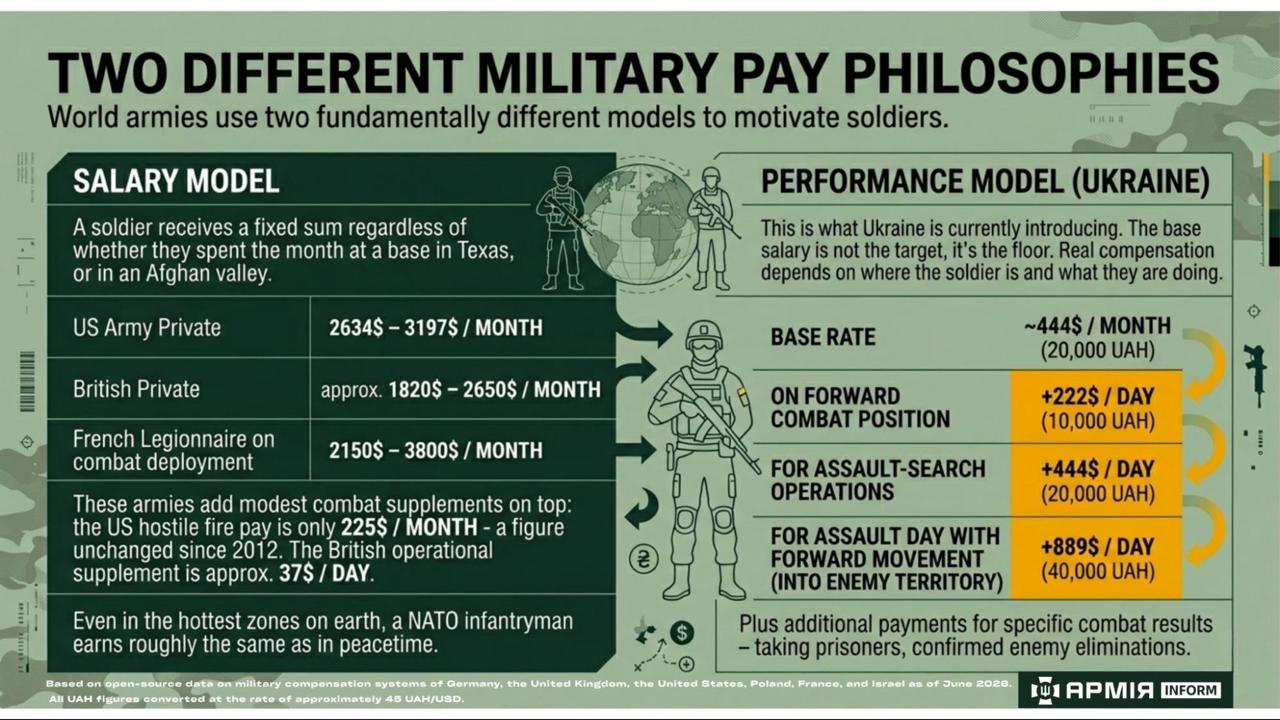
The world’s armies use two fundamentally different models for motivating soldiers.
The first is the salary model. A soldier receives a fixed sum regardless of whether he spent the month at a base in Texas or in an Afghan valley. The United States, United Kingdom, Poland, and France all operate on this logic.
- A US Army private earns a base salary of $2,634–$3,197 per month
- A British private earns approximately $1,820–$2,650 per month
- A French Legionnaire on combat deployment earns $2,150–$3,800 per month
These armies add modest combat supplements on top: the US Hostile Fire Pay reaches only $225 per month — a figure unchanged since 2012 that Congress is only now considering doubling. The British operational supplement is approximately $37 per day. In other words, even in the hottest zones on earth, a NATO infantryman earns roughly the same money as in peacetime.
The second is the performance model. This is what Ukraine is now introducing. The base salary is not the target — it is the floor. Real compensation depends on where the soldier is and what he is doing:
- ~$444 per month — base rate (20,000 UAH)
- +$222 per day on a forward combat position (10,000 UAH)
- +$444 per day for assault-search operations (20,000 UAH)
- +$889 per day for an assault day with forward movement (40,000 UAH) into enemy territory
Plus additional payments for specific combat results — taking prisoners, confirmed enemy eliminations.
This is management logic in the fifth year of a major war: pay more to those who risk more and do more. In this logic, Ukraine genuinely has no equivalent among the leading Western armies.
What the arithmetic actually shows
A concrete scenario: an infantryman who spends a month with three weeks on forward positions and participates in one assault will receive:
Base $444 + ($222 × 21 days) + $889 = approximately $6,000–$6,500 per month
That is roughly $185–$215 per day.
For comparison:
| Army | Monthly combat compensation |
| US Army (combat zone, all allowances) | $5,000–$5,500 |
| French Legionnaire (hottest mission) | ~$3,800 |
| Polish soldier (front line) | ~$1,850 |
| Ukrainian infantry (active combat month) | ~$6,000–$6,500 |
The only people in the world earning comparable sums for frontline infantry work are private military contractors. Mercenaries deployed by the UAE and Saudi Arabia in Yemen received up to $7,000 per month. But that is the private PMC market — not a state army with a legal contract, pension provision, and legal protection.
Why the salary model does not work for Ukraine
Critics of the new system often appeal to “stability” — soldiers need a predictable salary, not a lottery of combat payments. The argument sounds logical until you encounter the reality.
A fixed salary without connection to combat work creates two problems that the Armed Forces of Ukraine have experienced in practice.
First, it values completely different roles identically. A staff logistics officer and an assault soldier who goes under fire every day cannot earn the same money — it is unjust and demotivates precisely those without whom the front does not hold. Before the reform, the base rate for all categories was the same, and the only differentiation mechanism was combat supplements whose calculation often depended on a staff officer’s discretion.
Second, a fixed salary provides no instrument for attracting volunteers to the most dangerous positions. If the difference between rear service and an assault is a few hundred dollars, the rational choice is obvious. The new system changes that calculation radically: the difference between a base and an assault scenario is 10 to 15 times.
A model that resonates with the logic of the most dangerous professions
There are fields where the world long ago accepted the principle that higher risk means higher pay. Offshore oil extraction, deep-sea welding, industrial firefighting — everywhere, the base rate is supplemented by substantial allowances for specific working conditions.
Armies have traditionally lagged behind this logic — for reasons of equality and budget predictability. But the conditions of full-scale war, where frontline infantry bears an incomparably greater burden than any other military category, make this conservatism intolerable.
Ukraine’s reform is an attempt to bring the pay system into alignment with the real distribution of risk. In this sense it is not simply “high” — it is honest.
What “Highest in the world” actually means
Back to Fedorov’s claim. If interpreted literally — as a comparison of base salaries — it is vulnerable. If understood correctly — as a description of the potential compensation level for active combat work within a state army — it is accurate.
No regular NATO army pays a rank-and-file infantryman ~$6,500 per month for combat work. None. American, British, Polish, French — all of them remain within $2,000–$5,500 even accounting for all supplements and benefits. Israeli conscripts receive less than the minimum wage — the state treats service as an obligation, not a market contract.
Ukraine has chosen a different path: compete for infantry on an open market, including foreign volunteers, offering rates that exceed the private mercenary market. This is a conscious, pragmatic choice — and it corresponds to the scale of the task.
Motivation is not only money — but money is respect
No army in the world builds motivation on finances alone. The US bets on status, career advancement, and a benefits package. Israel relies on patriotism and collective responsibility. Britain draws on tradition and identity.
But there is a fundamental difference between a situation where society can afford to appeal to ideals, and a situation where a specific person walks under fire every day and comes back asking: Does the state sufficiently value what I do?
Adequate pay is not an alternative to motivation. It is its precondition. An army that pays its infantry the same as a rear-area administrator sends a signal: your risk and our risk are equivalent. The new system sends the opposite signal: we see the difference.
This is why the reform matters not only as a recruitment instrument, but as institutional recognition — a fact no less significant for those already serving than for those who still need to be persuaded.
The foreign dimension: opening the global market
Comparing salaries across armies only makes sense when we are comparing like with like. The base salary of an American private and the potential payment of a Ukrainian assault soldier are different categories with different logic.
Ukraine’s Defence Forces transformation is a bet that the most dangerous work should be paid according to real risk. It is a bet that no regular army in the world has made at this scale before.
June 17 — Ukraine took the next logical step: the Ministry of Defence announced it is preparing a new system to allow licensed private recruitment companies to bring foreign volunteers directly into the Armed Forces.
The stated ambition: up to half of Ukraine’s assault and infantry troops to eventually be legionnaires.
At ~$6,500 per month for an active combat deployment — in a state army, with legal protection, a defined service term, and a guaranteed deferment — Ukraine is no longer asking foreign fighters to choose between their conscience and their livelihood.
It is making the offer competitive.
The infantry costs a lot. That is the right decision.
Based on open-source data on military compensation systems of Germany, the United Kingdom, the United States, Poland, France, and Israel as of June 2026. All UAH figures converted at the rate of approximately 45 UAH/USD.
By Taras Tymchuk / ArmyInform