DIU: new Geran modification carries both a MANPADS and a warhead simultaneously


The Main Intelligence Directorate of the Ministry of Defense of Ukraine published an interactive diagram, components, and electronic component base of the Geran-2 UAV, series “E”, equipped with a man-portable air defense system (MANPADS).
The data were published on the War&Sanctions portal.
In response to the effective work of the Ukrainian Air Force and Army Aviation in destroying enemy UAVs, the adversary continues to adapt its unmanned platforms to engage aerial targets.
Previously, DIU reported the use of Geran-2 with a Soviet R-60 air-to-air missile. Today, details of a new configuration have been disclosed — now with a Verba MANPADS onboard.
Use of this modification предусматривает manual real-time control of the UAV by an operator. For this purpose, a Chinese Honpho TS130C-01 optical camera is installed in the nose cone, along with a Xingkay Tech XK-F358 mesh modem (PRC).
When an aerial target is detected, the operator sequentially activates two servos: the first launches the chemical battery and nitrogen cooling bottle for the MANPADS seeker head; the second — after cooling the seeker head to the required temperature — opens a specially manufactured protective cover. The missile trigger is fixed in a permanently pressed position using cable ties, ensuring automatic launch immediately after the seeker locks onto the target.
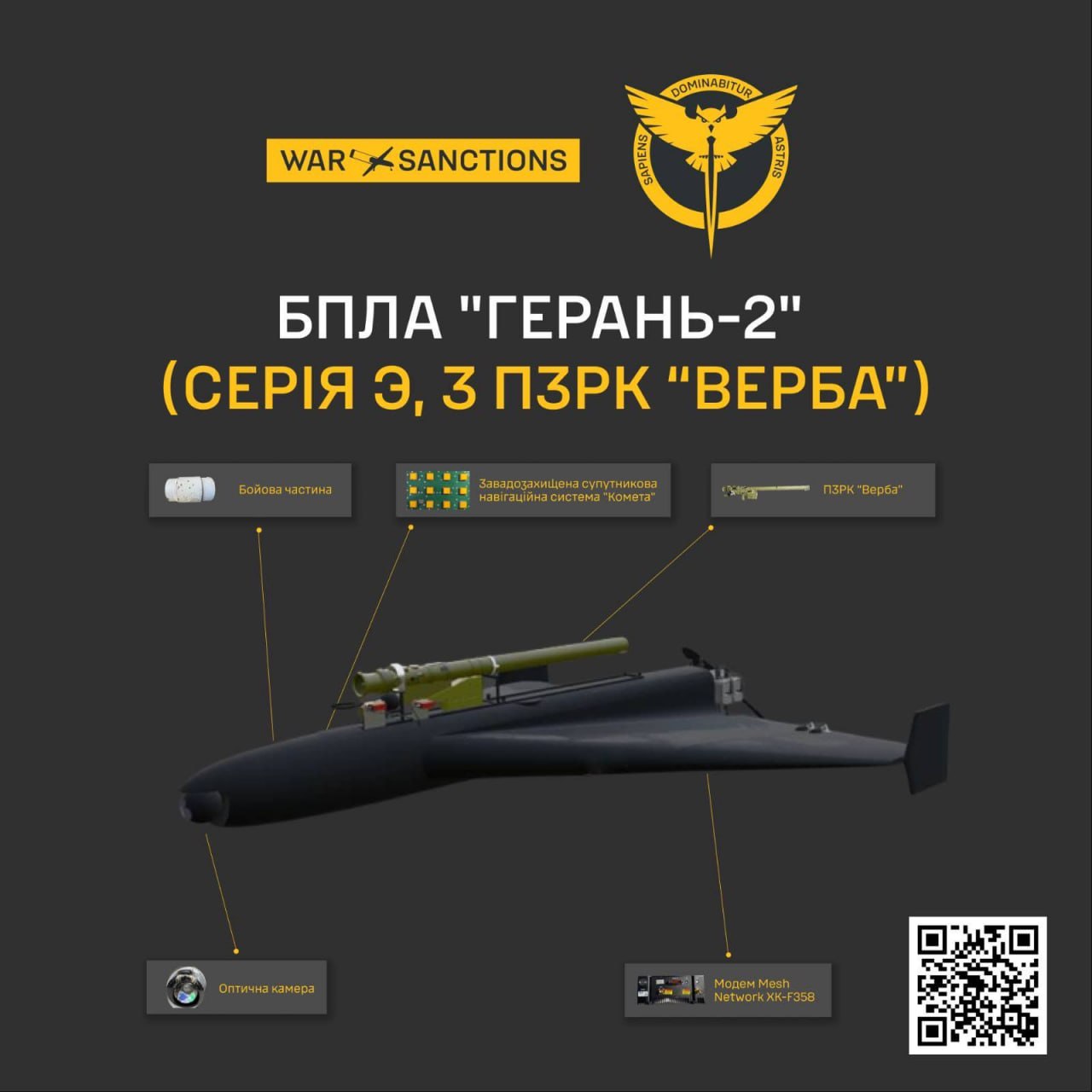
A key difference from the modification with the R-60 missile is the presence of a full-fledged primary warhead on the UAV itself. The HUR-examined sample was equipped with a TBBCh-50M thermobaric warhead.
Thus, after launching the anti-aircraft missile, the UAV retains the ability to carry out its primary strike mission. Target guidance can also be performed by the operator.
The set of units and components is standard for such Gerans: a flight controller, inertial navigation system, 12-channel Kometa, a tracker based on a Raspberry microcomputer, and 3G/4G modems, among others.
For the first time, the inertial navigation system was found to use a new six-axis inertial module SCH1633-D0I manufactured by Murata (Japan). This module was introduced at the end of 2024 as a solution for civilian automotive systems — autonomous driving and advanced driver assistance systems.
Countries of origin of the remaining electronic components include the United States, China, Switzerland, Taiwan, Japan, Germany, and the United Kingdom. A complete list of components with markings and photos is available on the War&Sanctions portal.
The publication of this data aims to expose the technological supply chains of Russian military aggression and to facilitate increased international sanctions pressure.