“Within a week, we laid 3,000 mines and drove the enemy into a ‘kill zone’”: how the engineers of the 91st Support Brigade turned drones into a tool of remote warfare


A support brigade is a unit commonly associated with fortifications, bridge emplacement, and the construction of engineering obstacles.
And that is indeed the case. However, today “support” has reached a new technological level: a significant portion of engineers’ work is now carried out remotely — with the help of unmanned systems.
ArmyInform reports on the combat routine of the Unmanned Systems Battalion of the 91st Separate Okhtyrka Support Brigade.
From enthusiasm to records: engineering mine warfare
“We are an unmanned systems battalion, but our brigade is essentially an engineering one. So even though we operate drones, we still remain engineers”, — says acting battalion commander Dmytro, callsign “Donbas”. — “The unit carries out specific engineering tasks: remote mining, installation of non-explosive obstacles, and logistics missions. And all of this is done using drones”.

According to “Donbas”, the history of the unit began in 2023 with a small group of enthusiasts. That was when the idea emerged: if drones can effectively “bomb” targets or deliver supplies, why not use them for mining as well?
“We were the first to start working with anti-tank mines using Vampires. Not for bombing, but specifically for mining. At first, everyone treated it skeptically: they said it was impossible, that from an altitude of 40 meters it was unrealistic to place a TM mine precisely on a road. But we proved that it was entirely possible. Our record is placing a TM mine exactly on a road from 80 meters”, — Dmytro recalls.

“On one sector, we laid more than 3,000 mines in a week”
Today, the unit uses a wide range of codified munitions against both vehicles and infantry. Dmytro notes that the targets most frequently destroyed are precisely those that cause the greatest trouble — the enemy’s fast and maneuverable motorcycles and ATVs.
“We make the ‘kill zone’ more effective, because part of the enemy losses comes specifically from our obstacles. Recently, on one sector, we laid more than 3,000 munitions within a week. This allowed us to redirect enemy assaults in the direction we needed and drive the enemy into a continuous ‘kill zone’. Now this section is showing very good results”, — says Dmytro.

The pilots’ work is extremely dangerous, since mining the enemy’s logistics routes requires getting as close as possible to the line of combat contact. But, as heavy bomber pilot Andrii, callsign “Bilyi”, — says, it is worth it.
“We move closer in order to fly as deep into the enemy rear as possible. The main task is mining logistics routes. Recently, a tank and two trucks hit my mines. There was fog, so they probably didn’t notice the mining, drove onto them, and stayed there”.
“If you disrupt logistics, the enemy won’t be able to bring up its pilots and EW systems. Then their infantry becomes suicidal”
The main goal of remote mining is to disrupt the enemy’s plans and sever its logistics, “Donbas” adds:
“If the enemy cannot move its electronic warfare systems or pilots closer because of disrupted logistics, then their frontline infantry simply becomes suicidal”.
-
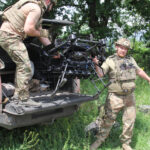
- Photo by Oleksandr Marchenko / ArmyInform

-
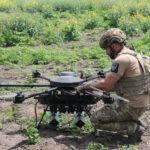
- Photo by Oleksandr Marchenko / ArmyInform

-
- Photo by Oleksandr Marchenko / ArmyInform

In addition to mining, the unit has mastered the installation of non-explosive obstacles using drones. This has several advantages: a drone can establish defensive lines in places a human simply cannot reach.
“I’ll put it this way: it is always better to send a drone than a soldier. A drone is just a piece of plastic and metal — it can be replaced. You can’t do that with a human being. Sometimes it seems more important to carry mines, but all missions are equally important. When in three nights we covered everything so thoroughly that the enemy was afraid to move toward the positions — that’s the result”, — says Dmytro.
“We created a breach in the road that stopped an enemy assault”
The battalion has a variety of systems in its arsenal. A specific drone is selected for each task: high-speed drones for operations in areas with active interception, heavy drones for specialized engineering missions.
“We have Vampire drones, Heavy Shot drones, and several others. For example, we use the Heavy Shot for ‘heavy tasks,’ because it can carry more powerful munitions. For instance, dismantling fortifications or creating breaches in roads to prevent the enemy from breaking through with vehicles. There was a case when, over two days, we created a breach in a road that forced enemy buggies and ATVs to stop during an assault. Meanwhile, our adjacent units destroyed them”, — recalls “Donbas”.

UGVs make the job easier and save lives
In addition to aerial drones, the battalion actively uses unmanned ground vehicles (UGVs), which also carry out specialized engineering tasks, says UGV operator with the callsign “Lev”:
“Our UGV can operate at distances of up to 30 kilometers. Its cross-country capability is good: it can carry 500 kilograms on its own, and even more with a trailer. This robot can even pull a vehicle out of the mud. Of course, UGV operations depend on the weather — mud is a major obstacle. But compared to doing this work manually, using a robot is far easier. And most importantly, it saves the lives of our guys”.
Of course, drones and unmanned ground systems cannot completely and fully replace specialists who work directly “by hand”. Instead, technology enhances their capabilities. Remote mining, the creation of obstacles, and logistics operations using unmanned systems significantly reduce risks for personnel, allowing the most dangerous tasks to be carried out remotely.