Defended a position for nearly a month and a half: How “Tsyhan” saved the wounded under Russian fire

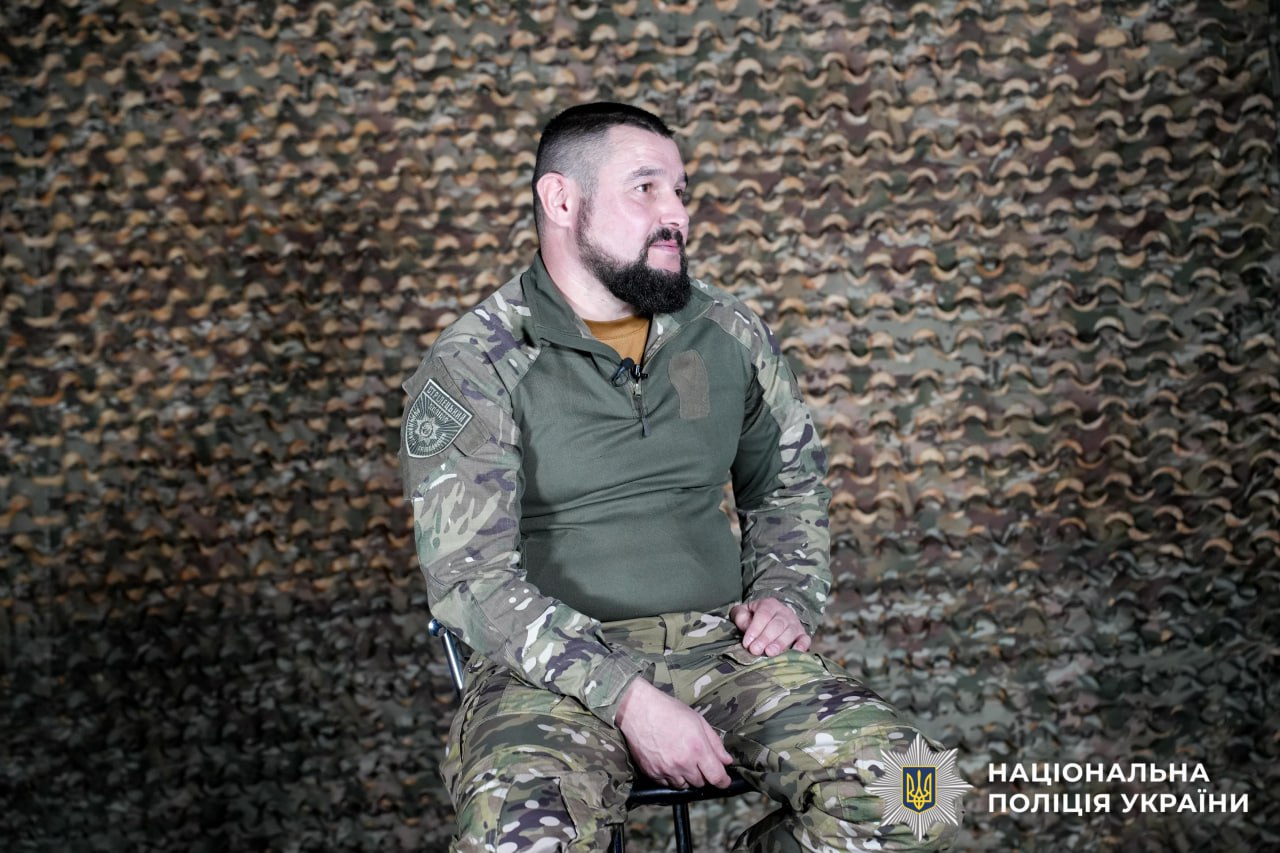
A police officer with the callsign “Tsyhan” served in one of the hottest directions in Donetsk region and repeatedly saved his comrades — carrying them out of the battlefield under intense enemy fire.
His story was shared by the National Police of Ukraine.
When the rifle battalion was being formed, the police captain immediately joined its ranks. After completing training, he served in the north, then in the Toretsk direction. His duty was to take up a position and hold the defense.
“Only after your first combat mission do you understand what war really is. Under constant drone attacks, you try to survive and begin to appreciate everyday things, such as having drinking water. There were times when four of us shared 400 grams of water, or drank river water. Dry ‘Mivina’ noodles or a small piece of sausage — and you’re already full”, — the fighter recalls.
There was an incident when Tsyhan went to take over a position together with police officers from the Rivne region, callsigns “Pups” and “Master.” Around 6:00 p.m., the latter stepped on an anti-personnel mine. His comrades immediately applied a tourniquet to his leg. Nearby there was a dugout, where they provided further assistance. Traveling at night was dangerous, so evacuation was postponed until morning.
“It was dangerous for anyone to reach us, so Pups and I acted on our own. Using a shovel and an antenna from the dugout, we made a crutch for Master. The three of us set out around 6 a.m. and covered only 1.5 kilometers in 12 hours.
We reached adjacent units, spent the night there, and asked for a cart for the wounded. The next day we covered about 3 kilometers to a casevac point. However, the vehicle arrived farther than agreed, so Pups and I carried Master in our arms”, — Tsyhan recounts.
The longest continuous stay of the police captain at a position lasted 41 days. During that time, he saved another comrade from the Rivne rifle battalion, callsign “Bars”.
In an abandoned dugout, Bars and “Pysanka” came under an attack by six FPV drones and sustained severe injuries. Pysanka was evacuated first by police officers from Odesa region who were nearby. Tsyhan and “Spice” went for Bars.
“Bars applied tourniquets to himself, but due to pain shock he loosened them. The first thing we did was tighten them again. Then we had to deliver him to medics. After loading him onto a two-wheeled cart, we moved out”, — the defender says.
The most difficult part was moving across completely open and destroyed terrain, where at any moment they could become targets for drones.
“When you’re alone, you can orient yourself and run quickly. But when there are three of you, it’s impossible. We understood the risk. But we had no other choice”, — Tsyhan adds.
After delivering Bars to a dugout on the outskirts of one of the settlements in Donetsk region, the police officers began loading the wounded one by one into a specialized medical ground robotic complex.
“As soon as we closed Pysanka inside the robotic system, a drone exploded behind us. Fortunately, it caught on branches, so Spice and I were hit by fragments. When the robot started moving, we immediately ran into the dugout, where we were given medical assistance”, — Tsyhan says.
All four are currently undergoing rehabilitation.
For his courage and heroism, the defender from Rivne region, Tsyhan, received the Armed Forces of Ukraine badge “For a Life Saved”.
Recently, he returned home from the front line. Waiting for him were his wife, his 16-year-old son and 13-year-old daughter, his parents, as well as his sister and brother. This was what gave him the strength to survive.