
The international delegation, headed by Ana Lucía Bueno, ICRC Public Health Coordinator, and Sujit Panda, Head of the Physical Rehabilitation…

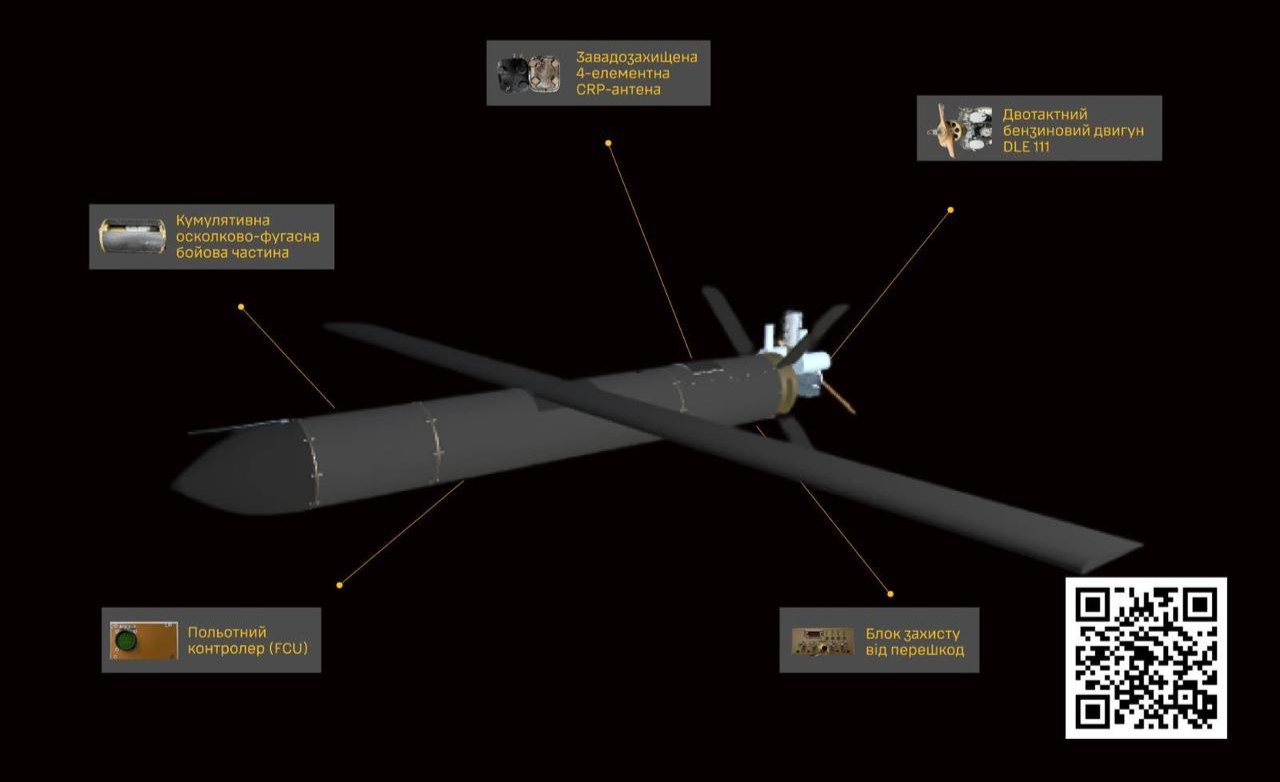
The Main Directorate of Intelligence of the Ministry of Defense of Ukraine has published the structure, components, and foreign element base of the Iranian UAV Shahed-107, which the Russian Federation has begun actively using in its war against Ukraine.
As noted by the DIU of the MoD, the data were published on the War&Sanctions portal.
“It was first publicly presented by the Iranian Islamic Revolutionary Guard Corps in June of this year during the escalation of the Iran–Israel conflict”, — the report says.
It is noted that the Shahed-107 is a high-wing type unmanned aerial vehicle with a wingspan of 3 meters and an X-shaped tail assembly that performs stabilization functions. The fuselage is made of carbon fiber, and the structural load-bearing elements are made of aluminum.
The examined sample is equipped with a cumulative high-explosive fragmentation warhead weighing 15 kg, similar in characteristics to other warheads of Iranian Shaheds.
“The powerplant is represented by a Chinese two-stroke gasoline engine DLE 111. Similar small-displacement engines have repeatedly been recorded in Russian UAVs such as ‘Herbera’, ‘BM-35’, ‘Parodiya’, and ‘Delta’. Considering the fuel tank capacity — 28 liters — the operational range of the Shahed-107 is about 300 km”, — the DIU of the MoD stated.
The navigation system is built on an inertial navigation system (IMU) similar to Sadra, a protective anti-jamming module, and a four-element anti-interference antenna. Flight control is carried out by a flight control unit (FCU), which transmits commands to the elevon and engine servos.
The geographical origin of the electronic component base of this UAV is traditional for Iranian and Russian developments: the USA, Switzerland, China, Japan, Taiwan, the Netherlands, and Ireland.
“The appearance of the Shahed-107 in Russia and its use against Ukraine is yet another proof of deepening cooperation between Tehran and Moscow. Iranian weapons continue undergoing combat testing specifically on Ukrainian soil — in confrontation with Western defense technologies”, — the DIU of the MoD noted.
The technological data obtained by the aggressors may be used in future destabilizing actions in various regions of the world.

The enemy is attempting to develop the production of naval drones and copy successful Ukrainian practices — both technical solutions and tactics.
Fighting continues in the northern part of the city of Pokrovsk in the Pokrovsk direction. A mechanized assault was repelled there the day before.
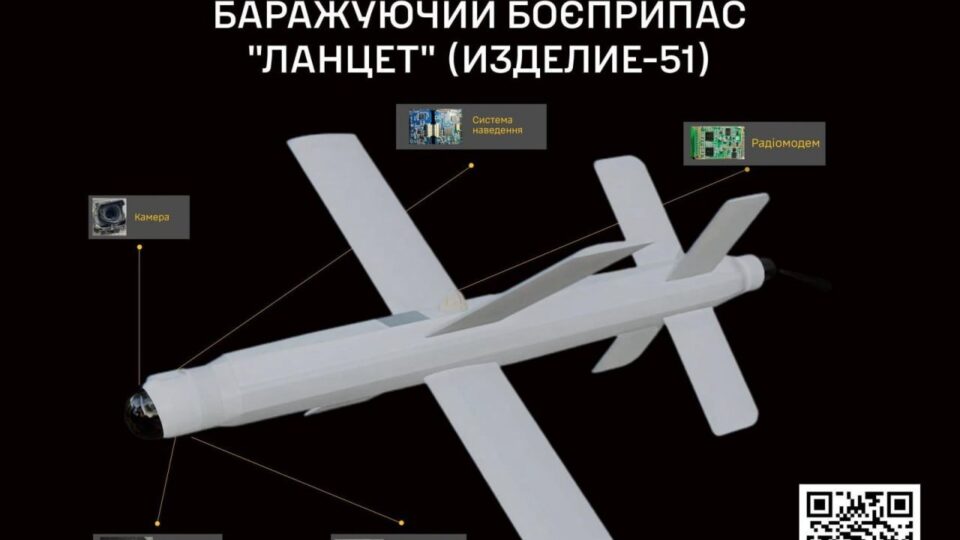
The Main Intelligence Directorate of the Ministry of Defense of Ukraine has published data on enterprises involved in the production of Russian loitering muniti

Another two-day round of negotiations between Ukraine and the United States concluded in Florida on March 22.
The enemy continues daily pressure and attempts to break through Ukrainian defenses in the Sloviansk direction.
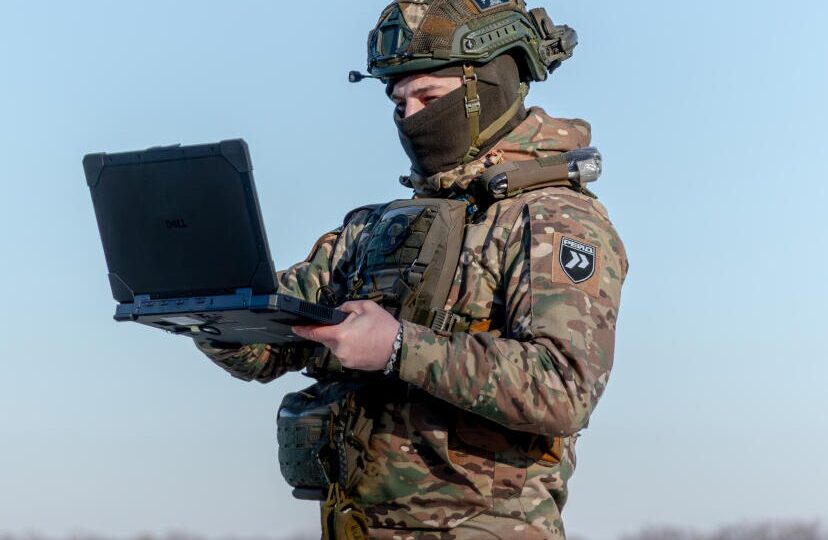
Over the past day, units of the Unmanned Systems Forces struck/destroyed 1,078 enemy targets.
The international delegation, headed by Ana Lucía Bueno, ICRC Public Health Coordinator, and Sujit Panda, Head of the Physical Rehabilitation…