The russian army is losing its willing recruits: Why money no longer guarantees new recruits for the kremlin

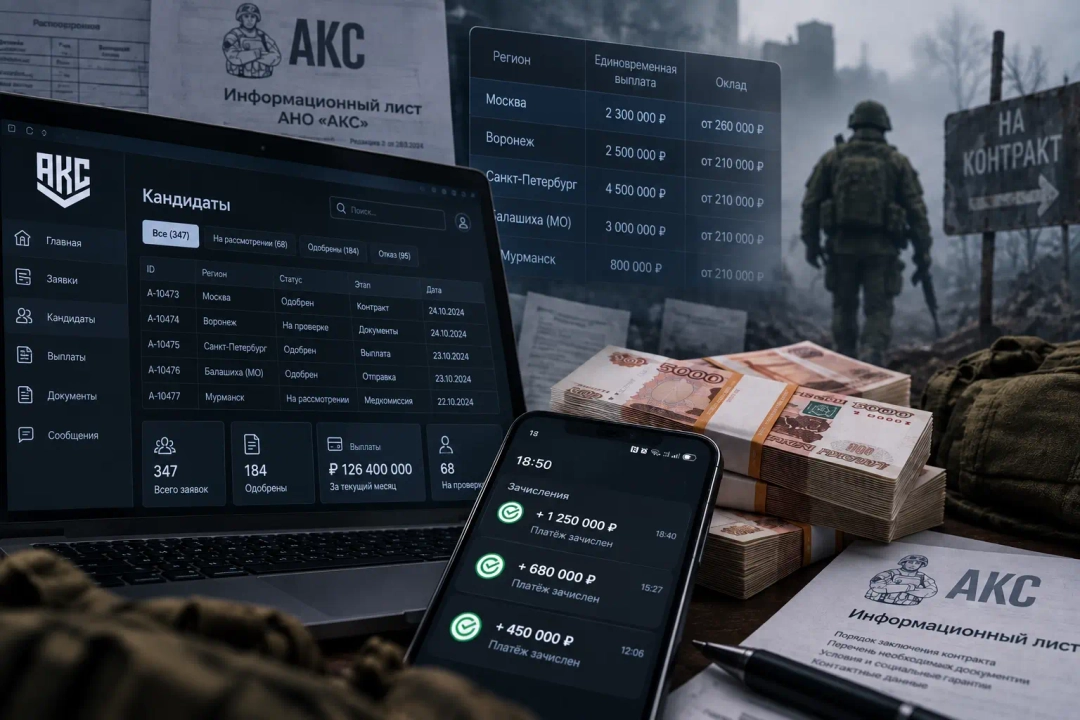
bashkortostan has officially acknowledged a decline in the number of military contract recruits.
Officials in dozens of regions are being punished for failing to meet recruitment targets, while human rights organizations are documenting an increasing number of cases of people being coerced into signing military contracts.
Is Russia approaching the limits of its covert mobilization model?
Russia’s military recruitment system, which for several years allowed the Kremlin to avoid another large-scale wave of mobilization, is showing increasing signs of strain. Money, promises of social benefits, multi-million-ruble payments, and aggressive advertising campaigns are no longer delivering the level of recruitment the Russian authorities expect.
One of the clearest warning signs has come from Bashkortostan. In November 2026, the regional authorities effectively acknowledged that the number of people willing to sign contracts with Russia’s Ministry of Defense was declining. They did so not in a political statement, but in an official budget document.
In the explanatory note accompanying the republic’s draft budget for 2027–2028, the reduction in spending on one-time payments to military contract recruits is explicitly attributed to a decrease in the number of people entering into military contracts.
The planned allocation for these payments was proposed to be reduced from 13.6 billion to 12.6 billion rubles. At the same time, the region retained its one-time payment of 1 million rubles for signing a military contract.
This is an important detail: Bashkortostan has not announced an end to recruitment, abandoned financial incentives, or suspended its efforts to attract people into the army. Yet even with the million-ruble payment remaining in place, the number of people willing to join the military is declining.
In effect, the regional authorities have acknowledged what Russian propaganda is trying to keep out of the spotlight: financial incentives no longer guarantee a steady flow of new recruits into the army.
bashkortostan: The human ost of the war that can no longer be hidden
The choice of this particular region for analysis is no coincidence.
Bashkortostan is among the Russian regions with the highest number of confirmed deaths in the war against Ukraine. According to data cited by The Moscow Times and Militarnyi, as of November 2026, the identities of 11,990 residents of the republic killed in the war had been established.
This is not the total number of deaths, but only the identified cases. The methodology used by Mediazona and the BBC is based on verifying reports from relatives, local media, official statements, and open-source data. The researchers themselves emphasize that such a name-by-name list does not include everyone who has been killed.
In other words, behind the official budget decision lies not an abstract decline in interest in military service, but a region that has already paid an extraordinarily high human price for the war.
There is another indicator of financial strain. In May 2026, the authorities in Bashkortostan cut the one-time compensation payment to the families of fallen servicemen from 2 million to 100,000 rubles. This represents a twentyfold reduction from the previous amount.
The result is a paradoxical situation: the Russian authorities continue spending substantial sums to attract new people into the army while simultaneously cutting payments to the families of those who have already been killed.
This is also a signal to potential contract recruits. The millions promised by the state do not necessarily mean that it will be equally generous in fulfilling its obligations to their families.
Another factor should also be taken into account: information about the dead spreads within the regions themselves. In small towns and villages, military casualty statistics cease to be numbers seen on television. They become stories about neighbors, classmates, relatives, and acquaintances.
Not just bashkortostan: Recruitment is declining in other parts of russia too
The case of Bashkortostan would be less significant if it were an isolated problem affecting just one region. However, data from independent researchers points to a broader trend.
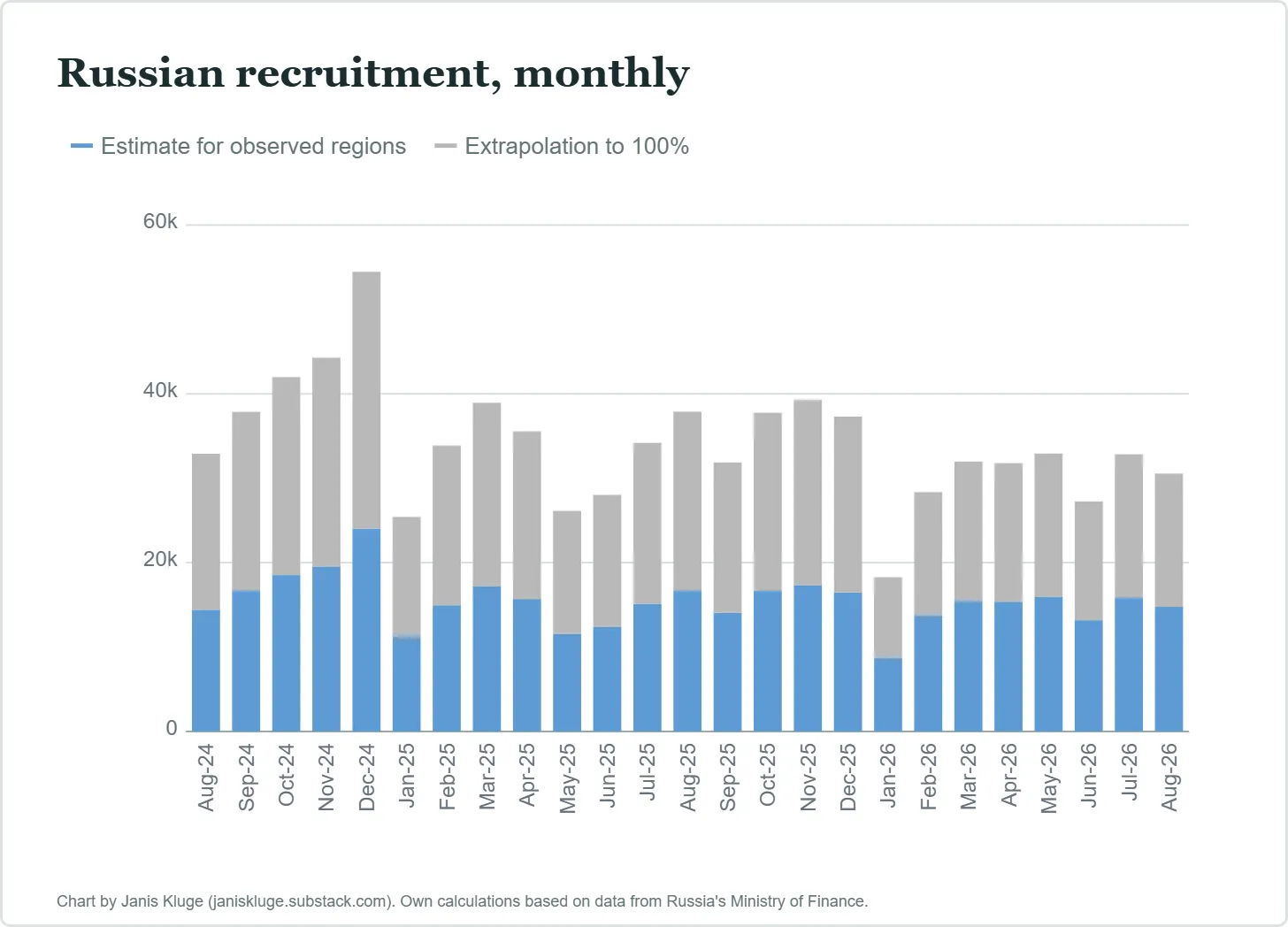
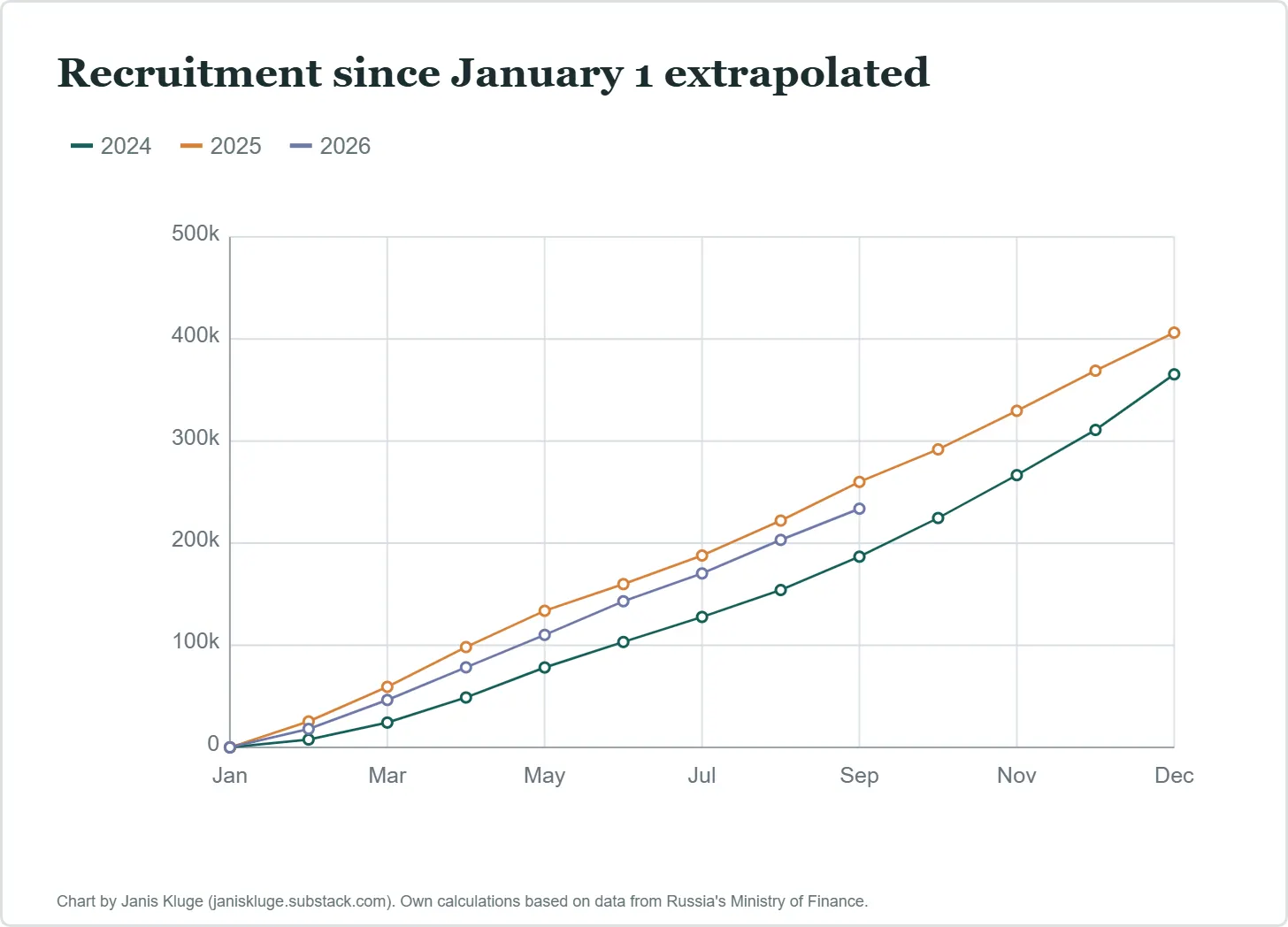
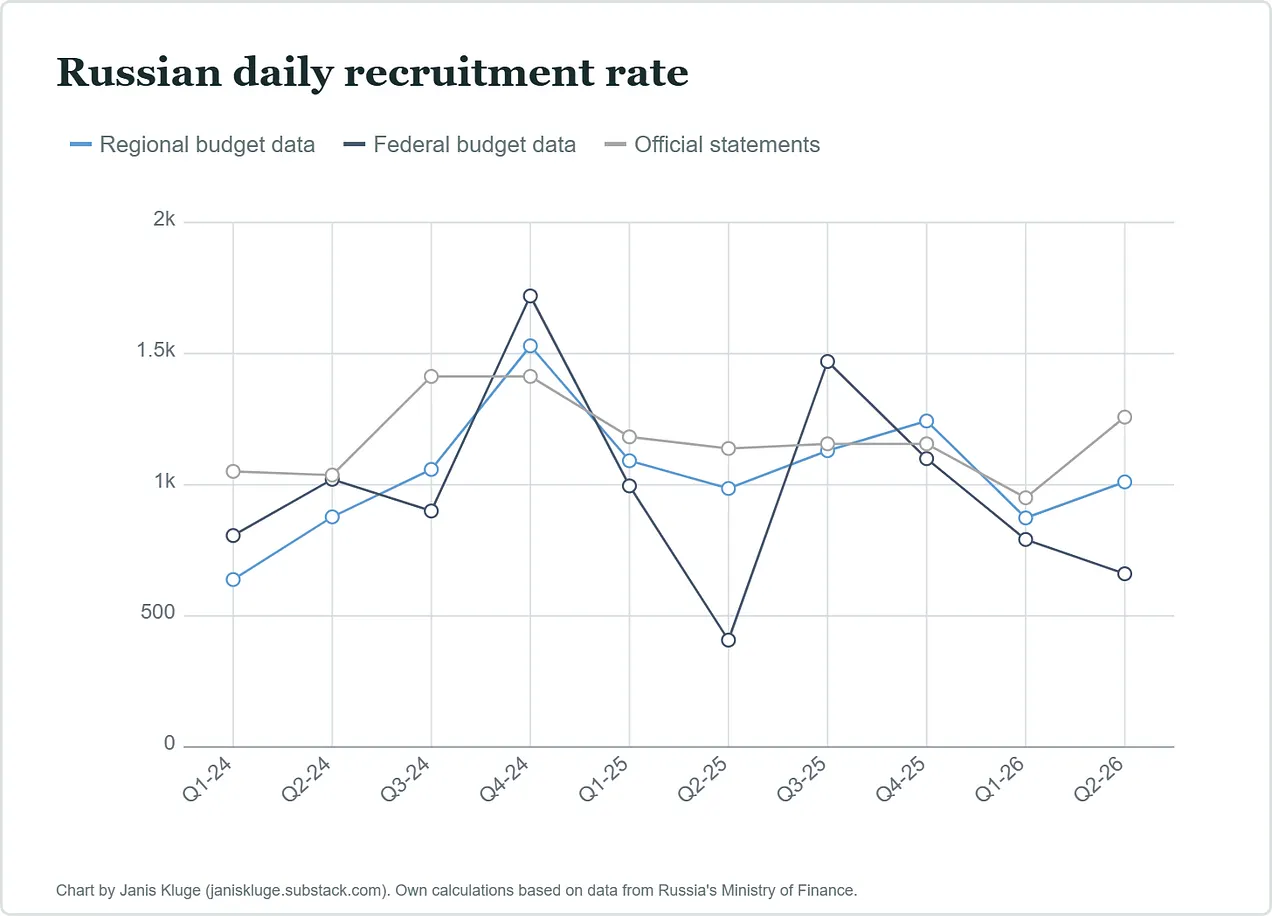
German researcher Janis Kluge, a research fellow at the German Institute for International and Security Affairs (SWP), estimates that approximately 234,000 new contracts with Russia’s Ministry of Defense were signed between January and August 2026.
For comparison, approximately 260,000 contracts were signed during the same period in 2025. This represents a difference of around 26,000 people, or 10%.
August is particularly revealing: according to the researcher’s estimates, recruitment rates that month were approximately 20% lower than a year earlier.
This happened despite Russian regions increasing the bonuses offered for signing military contracts. According to Kluge’s calculations, the average regional signing bonus had reached approximately 2.34 million rubles by early September 2026.
In other words, Russia was offering increasingly large sums of money but getting fewer recruits in return.
This matters more than the recruitment decline itself. If increasing financial incentives fail to restore previous recruitment rates, the problem may no longer be the amount of money on offer, but people’s unwillingness to risk dying in the war.
Another illustrative example is Moscow.
According to data previously published by Militarnyi, the number of people willing to sign military contracts in the capital fell by approximately one-quarter in 2025 compared with the previous year. A total of 24,469 people were sent to war through the capital’s recruitment centers over the course of the year. In December, only 879 people signed contracts — the lowest monthly figure since the center began operating.
This is particularly interesting given that Moscow has significantly greater financial resources than most Russian regions. High payments, developed advertising infrastructure, and the ability to recruit people from different parts of the country have not ensured steady growth in recruitment.
The problem, therefore, is not limited to poorer ethnic republics or remote territories.
Bratsk: When the state cannot meet its own recruitment targets even with administrative pressure
An even more telling example is the Russian city of Bratsk in Irkutsk Oblast.
According to a study of court rulings published in September 2026, the city was assigned a target of recruiting 645 military contract personnel for 2025.
To meet this target, the city administration launched a large-scale campaign. It held 71 operational headquarters meetings, and from September onward, these meetings took place daily. Two dedicated positions were created, while three mobile teams of officials and police officers visited more than 14,000 addresses and conducted nearly 3,000 conversations with residents.
Other methods were also used, including advertising materials, announcements, and even recruitment notices in utility bills.
The result? By November 1, only 369 people had agreed to go to war out of the planned 645.
That is approximately 57% of the target.
Particularly cynical was the attempt to recruit more than 260 orphans and graduates of children’s homes who were waiting to receive housing. In the end, only one person signed a contract.
This episode demonstrates more than just recruitment difficulties. It shows how deeply the military recruitment campaign has penetrated Russia’s civilian administrative system.
Local officials are effectively turning into recruiters, while meeting military recruitment targets is becoming another measure of their job performance.
51 regions face penalties: Voluntary military contracts are becoming an administrative obligation
In September 2026, researchers analyzed 61 court rulings related to failures to meet military contract recruitment targets.
According to their findings, at least 51 Russian regions have administrative penalties in place for officials who fail to meet recruitment targets. Another 21 regions have regulations allowing penalties for related violations.
One example is Nevinnomyssk in Stavropol Krai. Of the 19 contract recruits planned, only 11 were recruited.
In Turkmensky District, the target was six people, but only four signed contracts. The deputy head of the municipality was fined 30,000 rubles.
One detail is particularly important: during court proceedings, officials complained that they could not guarantee these targets would be met because signing a contract with the Ministry of Defense is legally voluntary.
This effectively exposes the central contradiction within Russia’s system.
On paper, contract military service remains voluntary. In practice, the state sets numerical targets, monitors their fulfillment, and punishes local officials for failing to recruit enough people.
In other words, voluntariness is becoming a formality, while responsibility for replenishing the army is gradually being shifted from the military establishment to civilian administrations.
When people do not volunteer, authorities start looking for them by force
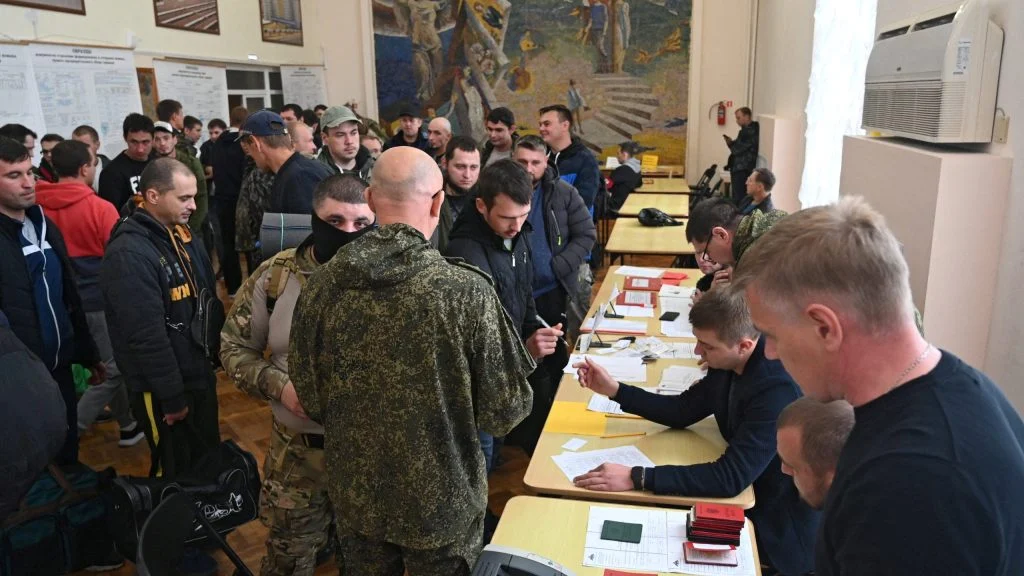
An even more alarming trend is the growing number of reports about men being forcibly recruited into military contract service.
According to information from human rights organizations published by Novaya Gazeta Europe and Verstka, reports of coercive recruitment came from at least 17 Russian regions during the summer of 2026.
The cases described include men being detained on the streets, taken to police stations and military enlistment offices, threatened with criminal prosecution, physically assaulted, and forced to sign documents.
Human rights activists reported cases in Penza, Omsk, Izhevsk, Arkhangelsk Oblast, Tatarstan, Udmurtia, Buryatia, and other regions.
In August, the situation expanded even further. According to data published by Verstka on October 22, reports of violent detentions and coercion into signing military contracts had come from at least 33 Russian regions and occupied Crimea.
Separately, the human rights organization Idite Lesom reported receiving 26 appeals concerning detentions and coercion into signing contracts in August alone, as well as 51 appeals from conscripts and their relatives concerning pressure to sign military contracts.
It is important to understand that these figures represent appeals and documented reports, not a complete count of all such incidents. They do not make it possible to establish the exact number of people forcibly recruited, but they reveal the geographical spread and growing scale of the problem.
New accounts emerged in early November 2026. According to reports from relatives and human rights activists, 25-year-old Sergei Kurakulov was beaten in Stary Oskol, and his signature on a military contract was allegedly forged, according to his family. The man was subsequently sent to an assault unit. On October 21, he went on a combat mission and stopped responding to contact.
Other reports concerned men from Izhevsk and Petrozavodsk who, according to relatives and human rights activists, were also forced to sign contracts or deceived into joining military service.
These stories should not automatically be treated as independently verified investigations of every individual incident. However, their recurrence and geographical spread are important indicators of how Russia’s recruitment system is changing.
Why are russians turning down millions?
The reasons cannot be reduced to a single factor.
First: The real cost of signing a contract.
Russian advertising presents military service as an opportunity to solve financial problems quickly: receive millions of rubles, pay off loans, provide for one’s family, or buy a home.
But a contract with Russia’s Ministry of Defense is not an ordinary high-paying job. It means entering a system in which the risk of being killed or seriously wounded is immediate, while the ability to terminate one’s service independently is limited.
The Russian authorities have repeatedly amended legislation to ensure that military contracts remain in force under mobilization conditions. As a result, a promise to earn money over one or two years can turn into an effectively indefinite period of military service.
Second: The accumulation of information about casualties.
Even under censorship, relatives of those killed publish reports, regional administrations hold funerals, and local media report on the dead and missing.
The name-by-name lists compiled by Mediazona and the BBC, regional memorial pages, and families’ accounts create an alternative picture of the war that is harder to conceal behind television rhetoric.
People may not know the full casualty figures, but they can see what happens to those who have already signed military contracts.
Third: The financial exhaustion of the system itself.
Payments for signing military contracts consist of federal and regional components and, in some cases, are supplemented by municipal bonuses.
This means that an increasingly large share of the cost of replenishing the Russian army falls on regional budgets.
An August 2026 study by the Centre for Eastern Studies (OSW) points to growing financial pressure on regional budgets as a result of the war. In a number of regions, spending on civilian needs, including healthcare and municipal infrastructure, is being reduced.
When a region is forced to finance recruitment, payments to military personnel, and other wartime obligations simultaneously, its resources for further increasing bonuses are not unlimited.
Fourth: Competition for labor.
Russia’s labor market also affects recruitment. In reports on the failure to meet recruitment targets in Bratsk, the local authorities cited relatively high wages at civilian enterprises as one of the reasons for the shortfall.
For someone who has a stable job, a family, and an opportunity to earn a living without risking deployment to the front, even a substantial one-time payment may not seem like sufficient compensation.
This is particularly important for the Russian economy, which itself needs workers in industry, construction, transportation, and other sectors.
The kremlin’s paradox: Fewer volunteers — more coercion
When all these facts are considered together, a clear pattern emerges.
On the one hand, the Russian authorities are increasing financial incentives, spending money on advertising, and expanding their network of recruitment intermediaries. On the other, regions are failing to meet their targets, officials are being fined, and human rights organizations are reporting an increasing number of cases of pressure on potential contract recruits.
This does not resemble a system that is confidently recruiting volunteers. Rather, it is a system forced to pay increasingly more to attract people while simultaneously intensifying administrative and coercive pressure.
The development of a private military recruitment market is also telling. In October 2026, The Insider published an investigation into networks of intermediaries searching for people to join the Russian army. According to the outlet, some recruiters can receive up to 1.25 million rubles for bringing in a single contract recruit.
In effect, an entire industry for sourcing military personnel has emerged around the war: from state recruitment centers and municipal administrations to private intermediaries who receive a fee for every person they recruit.
This further increases the cost of replenishing the army and indicates that the Russian state is no longer relying solely on the traditional work of military enlistment offices.
Does this mean russia is approaching another mobilization?
Not necessarily in the immediate future. It would also be a mistake to conclude that Russian recruitment is inevitably on the verge of collapse based solely on a 10% decline in recruitment.
According to Janis Kluge’s estimates, Russia recruited approximately 263,000 new contract personnel between January and September 2026. This is lower than during the same period in 2025, when the figure stood at around 292,000.
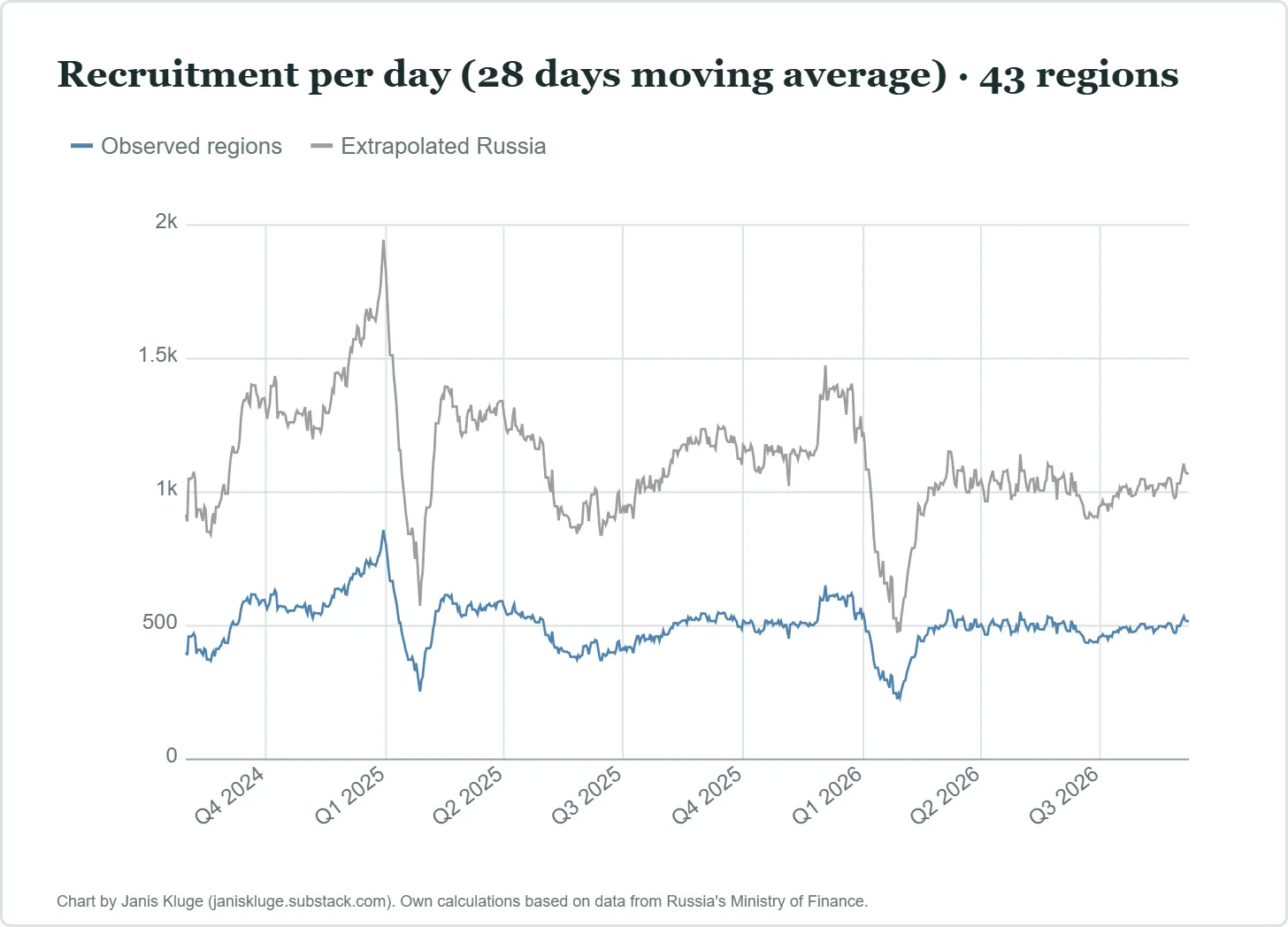
Nevertheless, this amounts to approximately 1,000 new contracts per day. This rate still allows the Russian army to receive substantial numbers of new personnel.
The problem lies elsewhere: to maintain these recruitment rates, the Kremlin has to spend more money, increase pressure on regional authorities, and expand coercive recruitment practices.
According to estimates cited by Radio Free Europe/Radio Liberty, based on Kluge’s research, Russian recruiters brought in approximately 29,900 people in September 2026, compared with 31,900 a year earlier. Total recruitment over the first nine months also remained below last year’s level.
Another indicator must be taken into account here: Russian army casualties. Even if the number of new contracts remains substantial, this does not automatically mean that the strength of Russia’s combat-ready forces is increasing. Deaths, wounded personnel, missing soldiers, those no longer fit for service, and the quality of training provided to new recruits must all be considered.
The balance between recruitment and casualties will determine whether Russia can continue sustaining the current intensity of hostilities without additional mobilization measures.
Therefore, assessing the situation requires monitoring not only the number of signed contracts, but also regional budgets, bonus amounts, failures to meet recruitment targets, court cases against officials, and reports of coercive recruitment.
Russia has not yet lost its ability to replenish its army, but the mechanism that previously allowed it to do so without an openly declared large-scale mobilization is becoming increasingly expensive and difficult to sustain.
Bashkortostan has exposed the financial dimension of the problem. Bratsk has demonstrated its administrative dimension. Reports from human rights organizations across dozens of regions reveal its coercive dimension.
And if the Kremlin was previously able to buy people’s willingness to go to war with promises of large sums of money, it is now increasingly having to seek out those who do not want to sign military contracts — and force them to do so.
This does not mean that Russia’s mobilization machine is grinding to a halt. But it increasingly demonstrates that voluntariness is becoming a scarce resource within it.