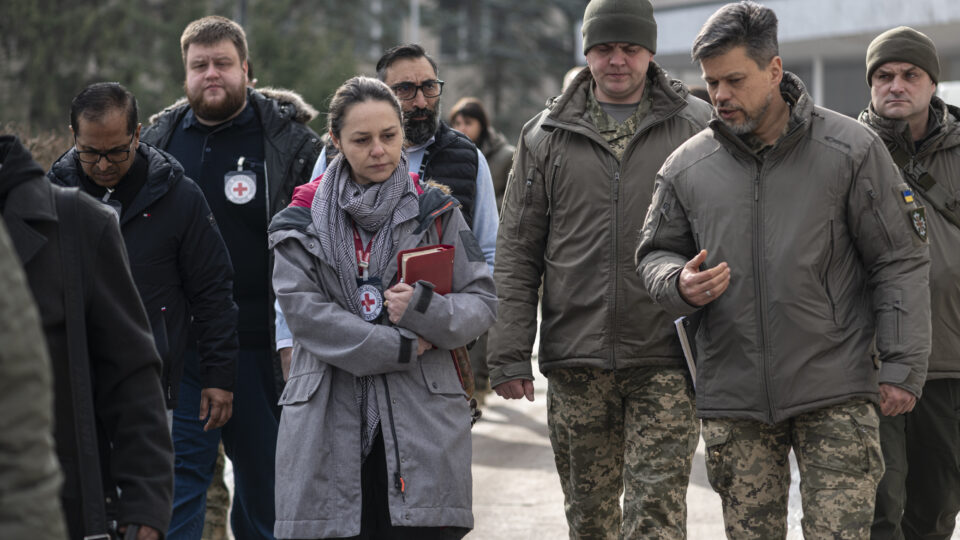
The international delegation, headed by Ana Lucía Bueno, ICRC Public Health Coordinator, and Sujit Panda, Head of the Physical Rehabilitation…


“I no longer ask when peace will come. I ask whether we will be ready for what comes after it”, — says Olena, a 36-year-old manager from Kharkiv who, over four years of war, has become a volunteer hub coordinator, a psychologist for her neighbors, and a drone specialist. “Because peace is not silence. It is even more challenges”.
Her words sound like a refrain echoing across many corners of Ukraine — in Sumy, Lviv, Zaporizhzhia, and Geneva.
Yes, even in neutral Switzerland, the same question is being asked:
“Who will protect us tomorrow? And what if it is no longer the army?”
A study that shatters perceptions
In 2024, the Swiss agency Armasuisse, together with the French collective Le Coup d’Après, conducted an unusual study. They were not looking for new weapons or strategies. They were looking for a new role for the citizen. Not a soldier. A person.
Instead of asking, “What kind of army should we have tomorrow?” they posed a different question:
“What kind of society are we defending — and together with whom?”
The answer surprised them: without an army — it is impossible. But with only an army — it is no longer enough.
New threats: not bullets, but waves
“We are preparing for the next war as if it were the previous one. But it has already begun — and it looks completely different”, — says one of the co-authors of the Swiss study.
The document “Qui nous défendra demain?” (“Who Will Defend Us Tomorrow?”) is not only about hybrid warfare. It is about a hybrid reality — a world in which identifying an attack is harder than surviving it. The enemy is not always in camouflage. And the threat is not always a missile.
The researchers identified nine areas of challenges that are already tearing apart the national fabric of even the most stable countries. Each of them has the destructive power of a real weapon.
More than 70% of residents of French-speaking Switzerland admitted that stress from work and daily life is the main source of psychological exhaustion. This is not just a bad mood. It is the erosion of trust, motivation, and the will to resist.
In Ukraine, this stress is multiplied by air raid alerts, losses, financial instability, and frontline news. It leads to depression, burnout, and indifference — all of which undermine resilience at a deeper level.
In 2024, France recorded 66,000 business bankruptcies — the highest number in the last 30 years. In Switzerland, this figure increased by 15%.
When the economy collapses, confidence in the future collapses with it — and so does readiness to resist. Business ceases to be the rear. Taxes stop flowing. The state loses room to maneuver. And worst of all, people begin thinking only about survival, not about the common cause.
On TikTok, YouTube, and even in messengers, every third piece of news about Ukraine contains manipulative elements or outright fakes.
This is not just distortion. It is a systematic operation to undermine trust, demoralize society, and provoke internal conflict.
The study cites the large-scale Doppelgänger operation, in which Russia created fake pages of Western media outlets to spread panic, doubt, and hatred.
Average temperatures in Switzerland have already risen by +2.8°C compared to pre-industrial levels — twice the global average. Glaciers have shrunk by 65% since 1850.
This means less water, more floods, disrupted logistics, rising prices, and new diseases. This is not just ecology. This is security. When snowstorms hit, transport stops. When rivers dry up, factories shut down. When heatwaves strike, crops die.
In France, 92% of respondents believe they live in an increasingly violent and divided society.
This is not just about likes or comments. It is about the erosion of a shared purpose. The feeling that “we are all different and each for themselves” is the perfect ground for external manipulation. An enemy does not need to conquer a country if it is fighting itself.
Young people in Switzerland aged 12–19 spend more than three hours a day online, mostly on TikTok, YouTube, and Discord.
War is no longer in the trenches. It is in news feeds. It is in algorithms. It is in a video with five million views saying, “It’s all pointless”.
If we lose this war, no drone, tank, or alliance will save the future.
Everyone who is not involved in the common cause is lost potential. And everyone who remains passive during a crisis is a vulnerability.
In Switzerland, discussions are already underway on how to engage senior citizens, how to leverage IT talent, and how to invest in civic organizations. Because defense does not always mean a rifle or a helmet. Sometimes it is a generator, a bandage, or timely information.
Global trends — from populism to authoritarianism — are undermining trust in democracies.
In such conditions, it becomes easy to impose an external narrative: “You are weak. You are betrayed. Do not fight”. This is information capitulation — before the first shots are fired.
When youth see no meaning and older generations no longer believe in change, a chasm emerges into which a nation can fall.
The report warns: identity, collective memory, values, and shared history are not abstractions. They are security infrastructure — just as vital as drones or air defense systems.
Not all threats sound like an air-raid siren. But all of them require a response.
We live in a time when silence can be more dangerous than an explosion, and manipulation more effective than shelling. This demands a different kind of response — not only heroism, but awareness.
Because in a systemic war, victory belongs not to those with more weapons, but to those with more prepared, united, and engaged citizens.
This is not a forecast. This is our present.
Ukraine as a model: we are already where others are only preparing to be
Irony — or perhaps a higher truth — lies in the fact that Ukraine’s experience has become the very model that Switzerland is only beginning to discuss as a future scenario.
Ukrainian resistance is not spontaneous heroism. It is a structural response of society to a systemic war.
Eight images of future defence, or where heroes come from
There is a moment in the Swiss report that unexpectedly resonates more strongly than all the charts and analytics. It is the stories — fictional, yet absolutely real.
Eight characters. Eight voices. Eight paths to a new defense.
Roberta, 72. A grandmother? Yes. But also a drone pilot preparing to drop survival kits in case of earthquakes or landslides. Because, she says, she does not want to be someone who “just watches disasters on television”.
Camille, a journalist. She wrote a book titled “How to Talk to Assholes” because she is tired of how disputes destroy democracy. She does not fight — she persuades. That is her front.
Naïm, only 19, has already created a Digital Sovereignty Index. He breaks stereotypes, exposes corporations, and bursts information bubbles. Not a hacker — a citizen with a code of honor.

These people sound like characters from a futuristic novel. But look around.
We have Svitlana from Dnipro, who teaches digital hygiene to the elderly.
We have Serhii from Chernihiv, who assembles first-aid kits and personally conducts tactical medicine training.
We have Oleh from Kremenchuk, who moderated 60 hours of discussions between displaced persons and locals without a single conflict.
All these fictional Swiss characters already exist in Ukraine — just with different names, in different places, under a different sky.
They are us, if we choose to act.
Because today, a hero is not always the one who shoots.
Today, a hero is the one who holds what must not be dropped: morality, calm, reason, and humanity.
After the War, there will be no “before”
One of the report’s key messages sounds like a warning:
“New threats do not replace old ones — they overlap”.
Even if the war were to end tomorrow, the threats would not disappear. Some would deepen: psychological trauma, disillusionment, poverty, lost generations, illusions.
That is why national resilience is a marathon. It is a recovery plan. It is a daily practice where defense is a responsibility, not just a function.
How can we be ready?
Learn to respond — not panic: first aid courses, digital literacy, crisis psychology.
Support — not criticize: volunteers, veterans, business, culture.
Participate — not stand aside: from local initiatives to national planning.
Defence is not armor. It is us
Once, in the 20th century, Switzerland said:
“It is not that we have an army. We are the army”.
Today, this phrase sounds different.
It is not the Armed Forces of Ukraine that protect us. It is we, together with the Armed Forces of Ukraine, who protect ourselves.
And the answer to the question “Who will protect us tomorrow?” is no longer rhetorical.
It is already in our hands.
And the path toward it can begin here: army.gov.ua.

The enemy is attempting to develop the production of naval drones and copy successful Ukrainian practices — both technical solutions and tactics.
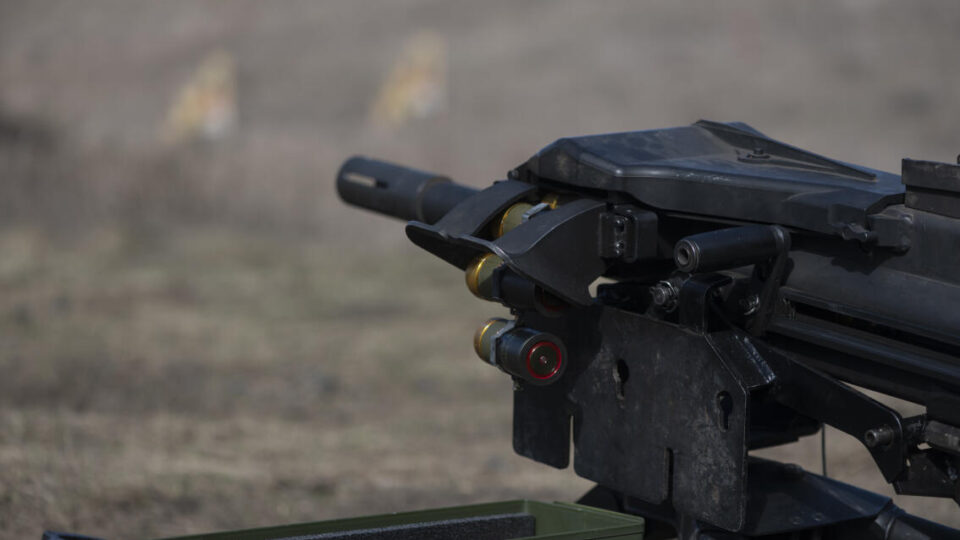
Fighting continues in the northern part of the city of Pokrovsk in the Pokrovsk direction. A mechanized assault was repelled there the day before.
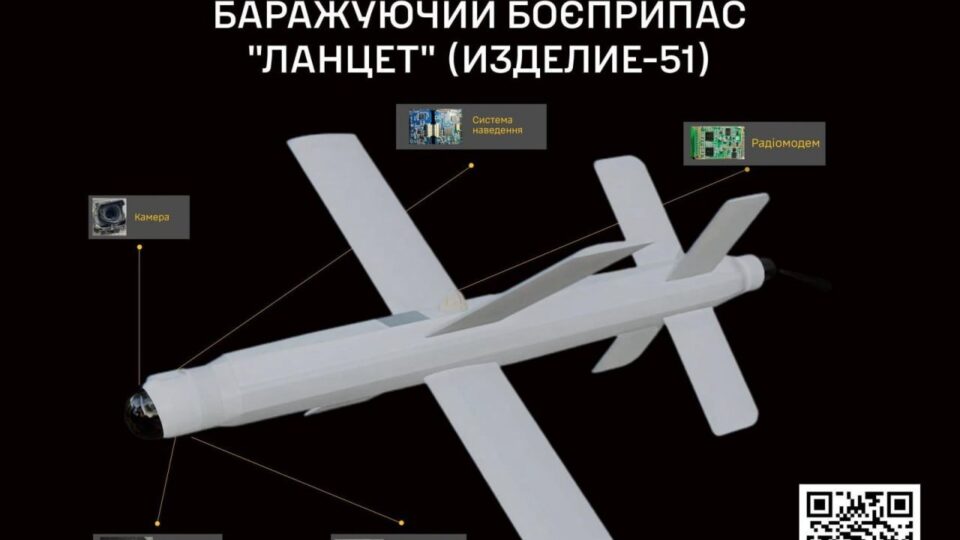
The Main Intelligence Directorate of the Ministry of Defense of Ukraine has published data on enterprises involved in the production of Russian loitering muniti

Another two-day round of negotiations between Ukraine and the United States concluded in Florida on March 22.
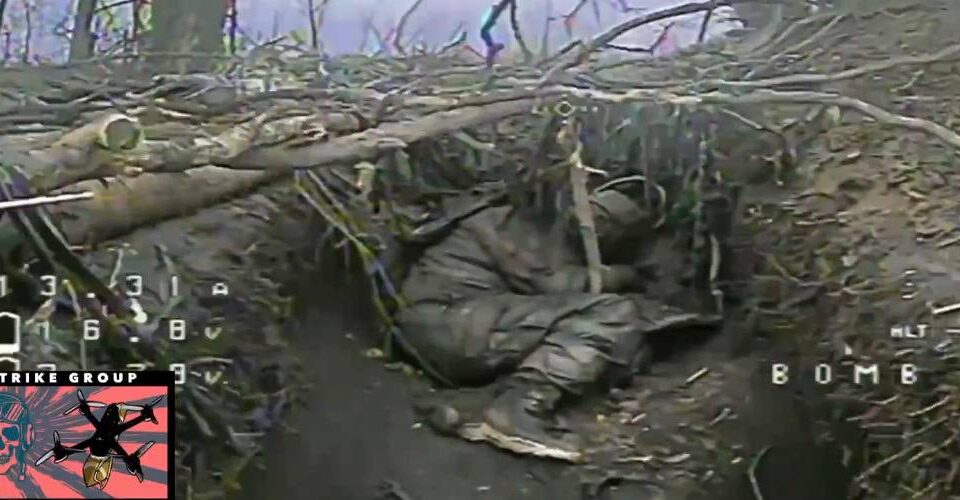
The enemy continues daily pressure and attempts to break through Ukrainian defenses in the Sloviansk direction.
Over the past day, units of the Unmanned Systems Forces struck/destroyed 1,078 enemy targets.
The international delegation, headed by Ana Lucía Bueno, ICRC Public Health Coordinator, and Sujit Panda, Head of the Physical Rehabilitation…