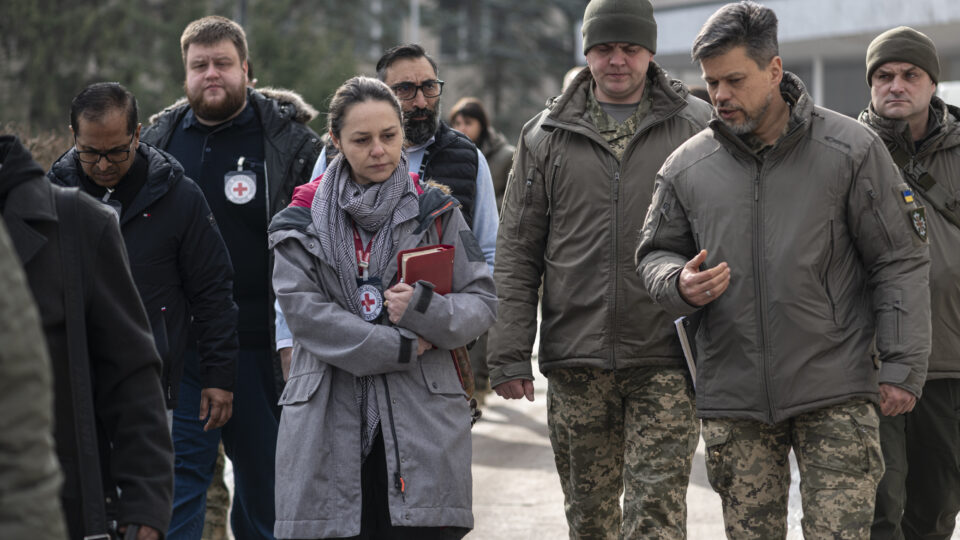
The international delegation, headed by Ana Lucía Bueno, ICRC Public Health Coordinator, and Sujit Panda, Head of the Physical Rehabilitation…


A discussion titled “Secret Sauce of Ukraine’s Victory: The Rise of New Defense Tech” recently took place in Kyiv.
A correspondent from ArmyInform attended the event and recorded key points, which largely concerned manufacturers, investors and representatives of allied countries that support us.
Against the backdrop of the ongoing war, where technologies change the battlefield almost every six months, combat unit representatives, manufacturers and international partners gathered for a frank conversation about the real state of affairs.
The event, organized by MITS Capital, aimed to reveal the “secret sauce” of Ukrainian resilience. However, two panel discussions — “The Next Defense Cycle: means and new challenges of technological warfare in 2026” and “How Big a Drone Wall Should Be: will Russian UAVs shift the front line into Europe” — quickly turned from an exchange of successes into a hard, sober analysis of a war of attrition and current challenges.
Following the discussion, ArmyInfom lists 9 key challenges that defined 2025 and 3 strategic conclusions/priorities for 2026.
1.The challenge of systemic incompatibility
Ukraine’s current innovative model challenges NATO’s model.
According to Perry Boyle: “Ukraine has something NATO cannot replicate. Each Alliance country effectively has one buyer — its national defense, its ministry of defense. … In Ukraine, because you have independent brigades that can buy on their own, you don’t have that monopoly economic problem, and I think that is one of the reasons why the innovation cycle here is so large — Ukraine has innovation because it has to survive”.
The challenge of this and coming years is how to integrate Ukraine’s fast, decentralized model into NATO’s slow, bureaucratic procurement system.
2. Infantry shortage
The most important challenge voiced by the military is a shortage of personnel.
“In the near future we will move everything into the kill zone and in that kill zone whoever is more effective will win and push that kill zone one way or the other”, — said Andriy Onistrat. — “That means we need to think ahead — how we should react to the challenges that exist on the other side”.
3. Adapting to a 500-meter kill zone
Technologies have compressed the battlefield. As Andriy Onistrat noted: “If a year ago 93% of all hits occurred at ranges up to 6 km, now we are operating at a distance of 500 m from the front-line positions”. This creates an extreme challenge for logistics, survivability and requires total EW protection on the last mile.

4.Middle Strikes as a blind spot
A critical challenge of 2025 was the weak ability to systematically strike the enemy’s logistics at operational depth.
“It seems to me that over this year we have not been able to launch strikes in the category of middle-strikes”, — said Artem Belyenkov. The challenge is to learn to destroy: “10 trucks before they turn into 15,000 FPV (drones) at the front”.
5. Invention vs. scaling
Ukraine faces a fundamental asymmetry.
Oleksandr Yabchanka observed: “We usually win at invention. In scaling, the enemy overtakes us. The enemy is more centralized”. Andriy Onistrat continued this thought: “When Ukrainian manufacturers say they can produce 200–300 units per month, that is a systemic challenge”, which, according to discussion participants, cannot be solved without international cooperation that can supply production scaling.
6. Overconfident manufacturers
The best R&D labs today are frontline workshops. However, the military point to a challenge: manufacturers do not always listen to them and feel too confident. Artem Belyenkov noted that: “I perfectly understand how critically important interaction is for the front — the speed of interaction between a unit and a manufacturer, when you influence, so to speak, the next batches that come to you. Internally — many manufacturers have already ‘caught someone by the beard’ and feel too self-confident”. In Artem’s view: “most should come back down to earth and realize we are still at war; scaling production in another country is good, but it must be a thought-out, structured process”.
7. The threat of “Rubicon”
One shortcoming named for 2025 by the military was neglecting the development of the enemy’s mobile EW:
“We missed the development of Rubicon… We slept through it”.
Now “building work against these units” is challenge No.1 for UAV survivability at the front.
8. Implementation of “non-media” technologies
Ground robotic complexes (GRCs) are a key to solving the infantry shortage, but their implementation faces a challenge. They “are much more expensive than UAVs” and, most importantly, “they are not as media-attractive.” “When a GRC carries logistics rather than striking targets as spectacularly as a drone, you can’t make a movie out of it”. This complicates fundraising and prioritization.
9. The shelf life challenge of innovations
Speed has become the main currency. Any technological solution has an extremely short lifecycle.
“In six months it will stop working cool, and in a year… it will stop working at all”, — emphasized Serhiy Blazhevych.
This creates a continuous challenge for R&D, requiring constant investment.
1. “Battlefield Certified” — the new global standard
Ukraine has de facto become the world’s only center for certifying defense technologies. Manufacturers and investors who ignore this proving ground will be left out of the market. Andriy Hrytseniuk, CEO of Brave1, noted: “If your products and developments are not used and have not proven their effectiveness on the battlefield in Ukraine, then you simply do not exist in the defense sector”.
Participants agreed on a common recommendation: Investments and R&D budgets should be directed only to products that undergo testing and receive feedback from the Ukrainian front. And R&D companies that want to succeed must be close to the frontline and to those who refine their experience and understanding of new developments.
2. Invest in systems that can be exported, not just new weapons
Victory is brought not by a single drone or a program, but by an integrated system.
Serhiy Blazhevych stressed: “A means is only one element of a system. Without the system, the means are worth very little”.
Perry Boyle went further: “The problem is how to attract enough money to Ukraine to build new defence companies to such a scale that we can start using that experience to create systems Ukraine can sell to Europe. It’s not only drones and tech. It’s the combination of tactics, how you organize a combat unit, what you centralize and what you decentralize on the frontline. It’s a very complex system, and I don’t even think Ukraine realizes how special it is.
Unfortunately, under these circumstances, it has indeed created something special that NATO needs, and the Alliance doesn’t even understand that it needs this and how necessary it is. There are people in NATO governments who understand this, but they are deeply stuck in their outdated procurement systems. One recommendation to manufacturers — think not about selling a “box,” but about how to integrate your product into a tactical system — comms, EW, command and control, logistics — that has already been built in Ukraine”.
3. Invest in people: the soldier’s new role and a new NATO training model
Technology does not remove humans from the equation, but it fundamentally changes their role. This requires a complete overhaul of training approaches. The soldier’s new role — he now becomes an operator of complex systems, a coordinator, a target analyst. A recommendation to international partners (Oleksandr Yabchanka and Bohdan Krotevych): “Every European country should build its own military-management link. Now Western generals come, look, take pictures… and leave. But they have the opportunity to enter a command post, a platoon, a company, live there, look at a combat operation, its planning. In Europe, commanders do not know how to lead an army in the conditions of this war at all… You may have 25 game-changers, but if you hammer nails with drones, you will fight like that. And that — is loss of people. To date there has not been a single case where a European country general simply arrived at a command post and lived there for a week. So invest in people, your soldiers, first of all. Force them to come to Ukraine. And 99.9% of Ukrainian military units will gladly share their knowledge”.
Summary from Bohdan Krotevych: “Today there are two countries that know how to fight in this world. One of them is your enemy. The other is Ukraine. That’s it. Europeans don’t have many choices (who to support now and whom to learn from)”.
Photo by the author
Taras Tymchuk
@armyinformcomua
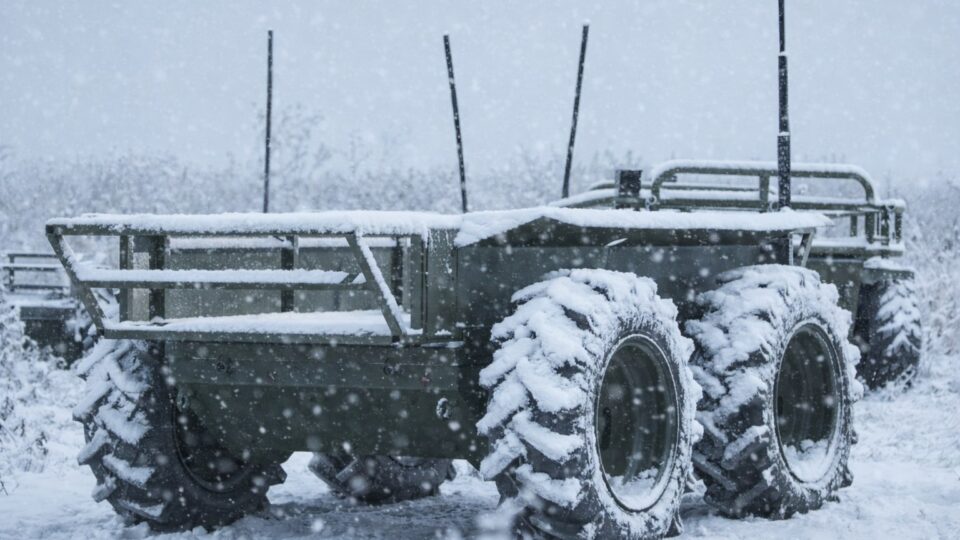
As a result of an enemy mine explosion, the soldier suffered a partial amputation of his lower limb. The wounded man could not move on his own, so the “Bizon” g
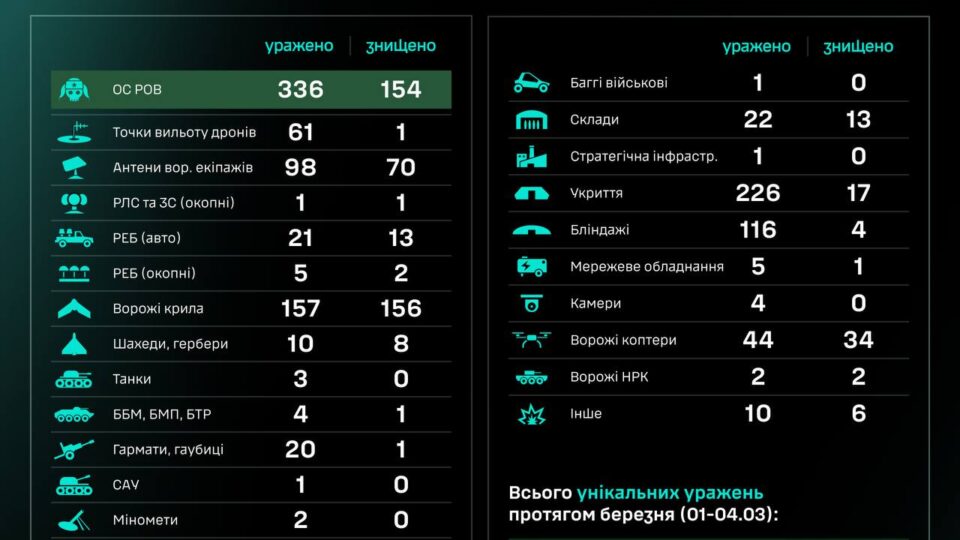
During the day, units of the Unmanned Systems Forces grouping struck or destroyed 1,281 enemy targets.
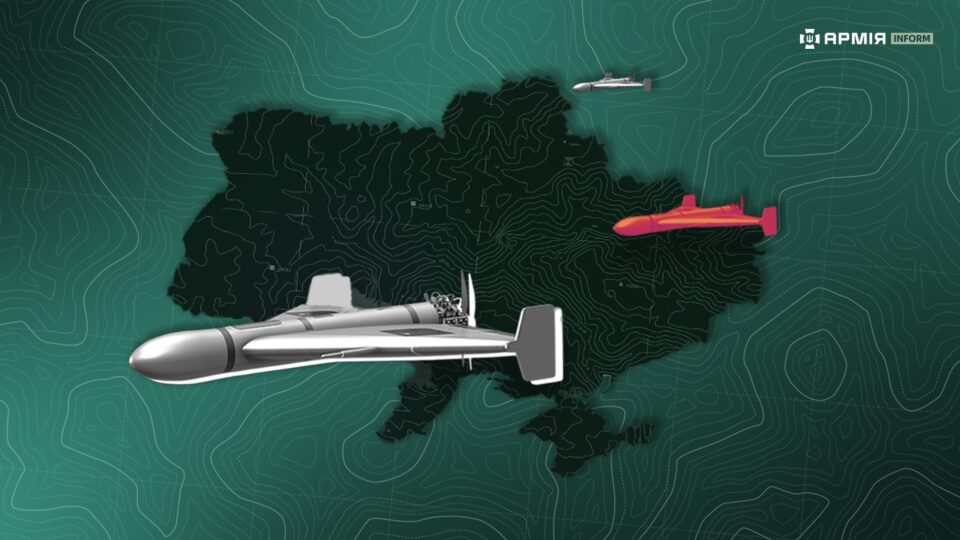
On the night of March 5 the enemy attacked with 155 strike UAVs of the Shahed, Gerbera, Italmas types and other types of drones, about 100 of them being Shaheds

Over the past day, the army of the aggressor country lost 900 personnel, four tanks and 41 artillery systems.

During December, January and February, fighters of the Unmanned Systems Forces struck 54 enemy SAM systems and radars.

Volodymyr Zelenskyy held a meeting on the challenges for Ukraine and partners, as well as on our ability to help protect lives and stabilize the global market.
The international delegation, headed by Ana Lucía Bueno, ICRC Public Health Coordinator, and Sujit Panda, Head of the Physical Rehabilitation…